
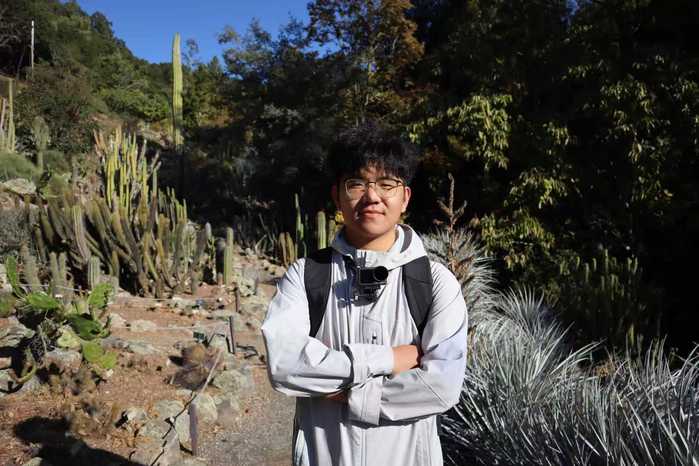
Jiang Panfeng ’26
Computer Science and Technology, School of Information Science and Technology (SIST)
High School: Wenling High School, Zhejiang Province
Honors and awards
-ShanghaiTech Outstanding Student (November 2025)
-Champion, Bay Area Decision Science Summit 2025 (March 2025)
-International Finalist (Top 0.1%) and AMS Award, Mathematical Contest in Modeling (MCM/ICM) (January 2025)
-Third Prize (Provincial Level), China Undergraduate Mathematical Contest in Modeling (November 2024)
Measuring the world through curiosity
Jiang Panfeng has long been driven by a passion for exploring the unknown. For him, the excitement of exploration lies not only in discovery itself, but in seeing ideas translated into real-world applications. He has skydived from 14,000 feet over Hawaii, enjoyed the thrill of snapping the last piece into place on a Rubik’s Cube, and loves immersing himself in unfamiliar cultures while traveling, constantly breaking out of his comfort zone. These outward explorations have shaped in him a mindset that goes beyond abstract thinking—one that continually seeks tangible impact.
Shift in perspective to stay grounded
Jiang’s shift from exploring the unknown to creating real-world value took place during his junior year. While on exchange at the University of California, Berkeley, he was struck by a professor’s commencement remark, “You have more opportunities than most to change the world—and to make others’ lives better.” This message prompted deep reflection: what should his work ultimately contribute? No longer satisfied with ideas confined to paper, he became determined to ensure that his work could be implemented and solve real problems.
This shift in perspective also helped him move past earlier setbacks, including two mathematical modeling competitions that yielded only participation awards and a rejected paper submission. Instead, these experiences pushed him to evaluate every project through two key questions: Can it be applied in practice? Can it create real value?
Refining through practice
Jiang’s commitment to real-world applicability has been validated through both competitions and research. In the 2025 Mathematical Contest in Modeling (MCM/ICM), he and his team tackled the issue of overtourism in Juneau, Alaska, developing differential equation models to predict tourist flows. After validating their model in Juneau, they extended it to Big Sur, California, demonstrating its scalability. The project earned both the International Finalist distinction and the AMS Award.
Later that year, at the Bay Area Decision Science Summit (BADSS), Jiang and his teammates succeeded, through clear role division and system simplification, to ultimately defeat teams from leading universities to win the championship.
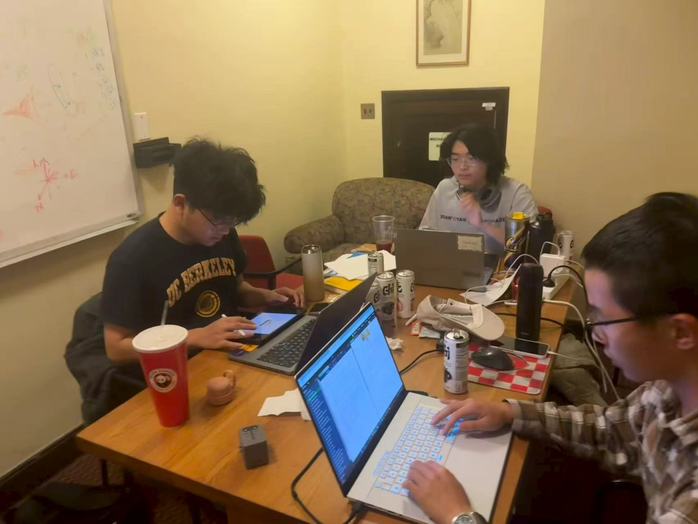
Jiang Panfeng (far left) and his teammates at the Mathematical Modeling Competition
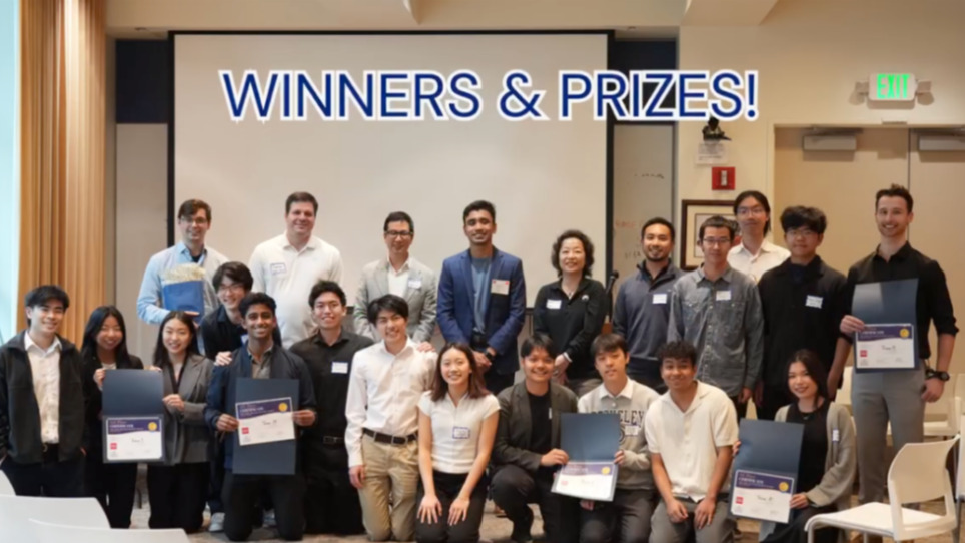
Group photo of the BADSS winners. Jiang Panfeng is second from the right in the second row
In research, Jiang has followed the path from exploration to application. Since his sophomore year, he has worked in the Mobile Perception Lab led by Professor Laurent Kneip at SIST, focusing on event-based vision, particularly improving the stability and accuracy of real-time LED detection modules.
Supported by university programs, Jiang has also conducted research as a visiting student at the National University of Singapore and the University of North Carolina at Chapel Hill, where he explored language-guided social navigation algorithms and noise-adaptive reinforcement learning frameworks. His work aims to bridge theory and application in areas such as robotic interaction and online decision-making. To date, he has contributed to multiple research projects, with two co-authored papers published at leading conferences such as ICCV and ICRA.
Returning to the ground is the true reward
For Jiang Panfeng, his undergraduate years represent a transition—from being captivated by exploration to exploring with purpose. As he reflects on skydiving, the leap itself is exhilarating, but the most enduring sense of fulfillment comes from landing safely on the ground.
He continues to embrace the spirit of exploration, but places greater importance on whether each endeavor can ultimately “return to the ground”—creating tangible impact in the real world. Guided by this philosophy, he will continue to write his own story of exploration, grounded in the pursuit of meaningful, real-world value.