

A team led by Professor Wang Qian from the School of Biomedical Engineering (BME) at ShanghaiTech University has published a new study in Cell Reports Medicine. The paper, titled “UniCAS: A foundation model for cervical cytology screening,” presents a specialized AI foundation model built for automated cervical cancer screening using ThinPrep Cytology Test (TCT) slides.
Cervical cancer screening is essential for early detection and prevention, but reviewing large whole slide images (WSIs) manually is time-consuming and demanding for pathologists. Existing AI models, often trained on tissue (histopathology) data, struggle with the varied and scattered cell patterns in cytology images. Traditional systems also require separate models for different tasks, making workflows inefficient.
To overcome these issues, the researchers pretrained UniCAS on a large dataset of 48,532 cervical WSIs from patients aged 15 to 90, covering diverse diseases and conditions. Using self-supervised learning (DINOv2), UniCAS learns detailed cell features without needing labeled data.
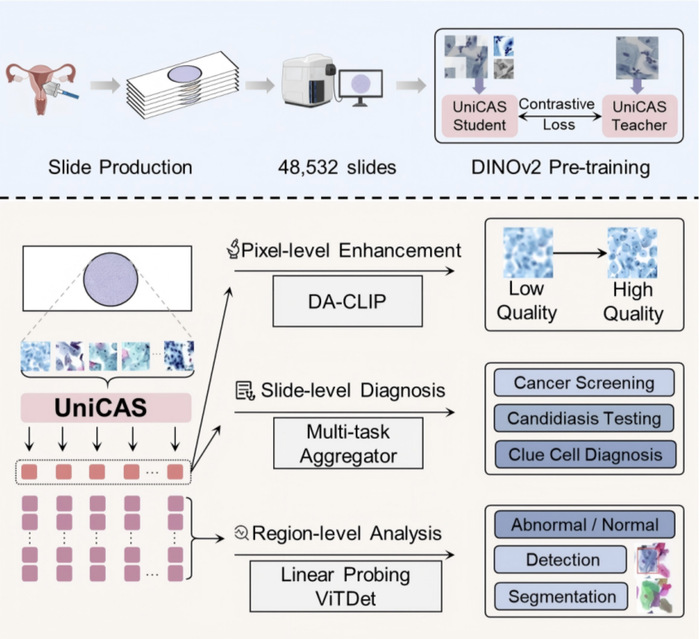
The schematics of UniCAS
Key features and results include:
Slide-level diagnosis: A new multi-task aggregator allows UniCAS to handle three tasks at once—cervical cancer screening, candidiasis testing, and clue cell diagnosis—on the same slide. It achieves high accuracy (AUC of 92.60% for cancer screening, 92.58% for candidiasis, and 98.39% for clue cells) and reduces processing time by about 70% compared to traditional methods.
Region-level analysis: UniCAS excels at classifying, detecting, and segmenting abnormal cells or infectious agents in specific areas of the slide, outperforming other models and providing clear visual aids for pathologists.
Pixel-level enhancement: It can improve blurry or low-quality scanned images, helping ensure accurate diagnosis.
The model also performs well on external and public datasets, showing strong generalization.
This work demonstrates the value of domain-specific foundation models for cytology tasks. By combining multiple analysis levels into one efficient pipeline, UniCAS helps bridge computational tools and real-world clinical needs, supporting better and more accessible cervical cancer screening.
PhD student Jiang Haotian and master’s graduate Cai Jiangdong (now at Tencent) are the co-first authors. Corresponding authors are Professor Wang Qian and Associate Professor Zhang Lichi from Shanghai Jiao Tong University. ShanghaiTech University is the first affiliation, with collaboration from the Shanghai Clinical Research and Trial Center.