

A research team led by Assistant Professor Peng Chang from the School of Biomedical Engineering (BME) has published a groundbreaking study in the journal Measurement. The paper reports a stretchable wearable Doppler ultrasound patch designed for continuous blood flow monitoring. This lightweight and flexible patch, which adheres stably to the skin during daily activities, has the potential to transform traditional hospital-based, operator-dependent blood flow checks into convenient, long-term home health management tools.
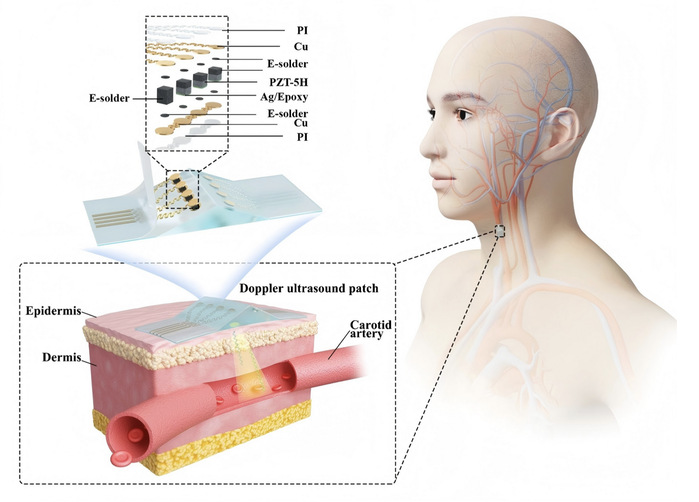
Schematic diagram of the stretchable Doppler ultrasound patch structure and exploded view of the ultrasonic transducers.
Blood flow velocity is a key indicator for cardiovascular health assessment, but conventional methods have significant limitations. Invasive techniques are accurate but carry risks of injury and infection, making them unsuitable for prolonged use. Common non-invasive Doppler probes require handheld operation, are bulky, and rely on expert experience; they easily shift during movement or joint flexion, preventing true continuous measurement. Peng’s team combined flexible electronics with innovative structural design to create this patch system, with a core area of about 2×4 cm and a weight of around 2 grams, shifting monitoring from short-term, fixed-point, and assisted operation to long-term, wearable, and self-use.
In terms of structure, the patch features six ultrasonic transducers arranged symmetrically in two groups, integrated onto a flexible substrate with a pre-set 30-degree tilt angle. When attached to the skin, this forms a stable 60-degree Doppler incident angle for probing subcutaneous vessels, minimizing errors from angle variations during wear and improving measurement accuracy and repeatability. The patch offers excellent conformability, with up to 30% elastic stretchability, allowing it to fit skin or curved joint areas without detachment or signal degradation.
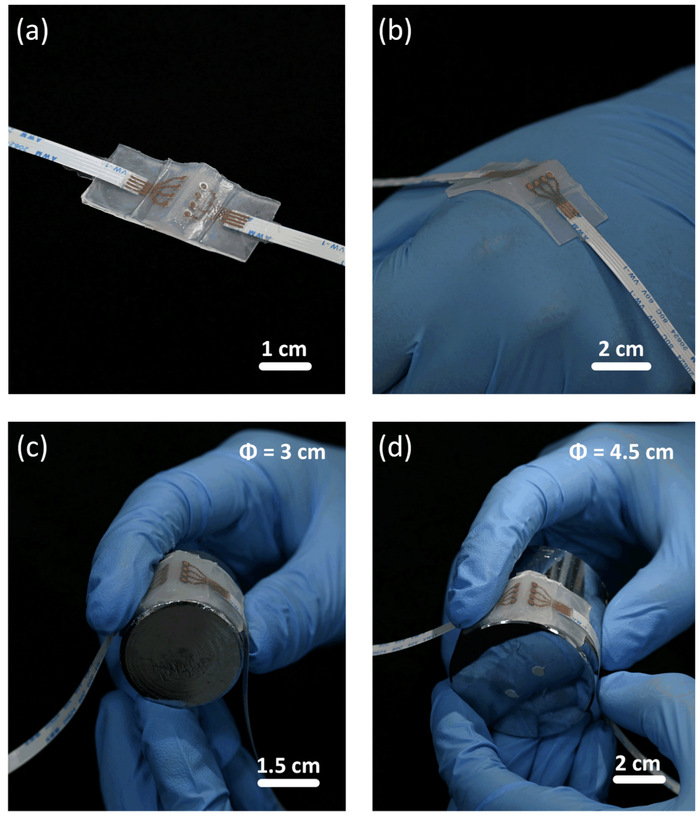
Physical demonstration of the stretchable Doppler ultrasound patch.
In the fabrication process, the team simplified the preparation of serpentine electrodes—a type of wavy wiring that prevents breakage during stretching—by eliminating traditional steps like transfer printing and spin-coating of Cu/PI, making production easier, lower-cost, and more reliable for stretchable interconnects. For signal processing, they adopted a slow-time sampling algorithm instead of conventional quadrature demodulation, reducing computational overhead while extracting Doppler frequency shifts to calculate blood flow velocity. Experimental results show errors of 4.1%–12% in the 20–100 cm/s range, with the ability to clearly capture pulsatile flow waveform changes, covering typical velocity ranges for major vessels like the carotid artery.
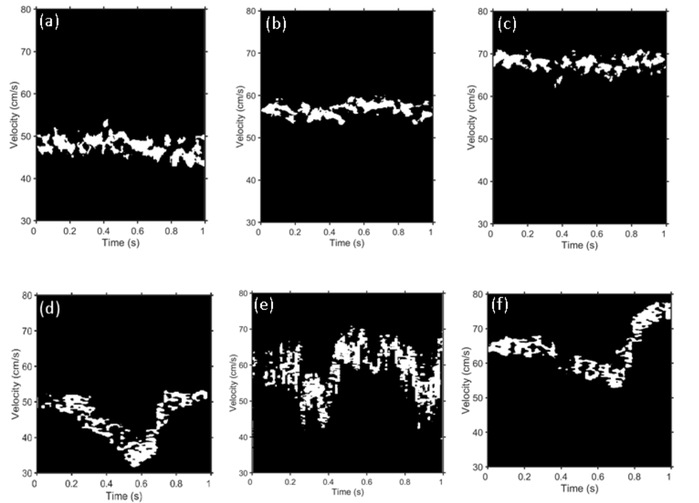
Measurement results of blood flow velocity using the stretchable Doppler ultrasound patch.
This stretchable Doppler ultrasound patch provides a new technological pathway for early screening and long-term follow-up of cardiovascular diseases. As wearable continuous monitoring becomes more stable, comfortable, and user-friendly, individuals can gain more real-time, everyday-accessible blood flow data to support health management and risk alerts. The first author is Li Yuanlong, a master’s student at the BME, and the corresponding author is Prof. Peng. ShanghaiTech University is the first affiliation.