

On December 12, Assistant Professor Xiang Yangfei’s lab at the School of Life Science and Technology (SLST) published a paper entitled “Human PSC-derived organoids model sympathetic ganglion development and its functional crosstalk with the heart” in the journal Cell Stem Cell. For the first time, this study reports the successful generation of human sympathetic ganglion organoids (hSGOs) from human pluripotent stem cells (hPSCs), as well as the three-dimensional in vitro reconstruction of functional connections between the sympathetic ganglion and the heart. This achievement provides a new platform for investigating the physiology and pathology of the human sympathetic ganglion and neuro-organ interactions.
Over the past decade, three-dimensional organoids have provided a new strategy for modeling the development and function of human organs. For the central nervous system (CNS), organoids modeling different brain regions and even specific nuclei, are used to recapitulate human brain development and to study interactions across regions. As another branch of the nervous system, the peripheral nervous system (PNS) transmits information from the CNS to organs and tissues across the body. However, the organoid models for the PNS remain limited.
Sympathetic ganglia are the critical components of the PNS. During the development phase, sympathetic neurons extend axons into peripheral targets such as the heart and vessels, and they regulate diverse physiological processes essential for maintaining body homeostasis. This study proposed a differentiation strategy to generate self-organized hSGOs from hPSCs that recapitulate key features of sympathetic ganglion development. In addition to sympathetic neurons, the organoids generated glial cells of the sympathetic ganglia, which support the development and functional maintenance of sympathetic neurons. During long-term culture, the hSGOs exhibited progressive structural and functional maturation.
To model sympathetic innervation of the heart in vitro, the researchers assembled hSGOs with human heart-forming organoids to construct the human sympathetically innervated heart-forming organoids. Using retrograde tracing, multi-electrode array recording, optogenetic stimulation, and other approaches, they demonstrated structural and functional coupling between sympathetic neurons and cardiomyocytes. This system enabled the assessment of factors influencing human cardiac sympathetic innervation, including developmental regulators and pathological insults. They further revealed that the inter-tissue connections reciprocally affected the development of both human sympathetic and cardiac tissues.
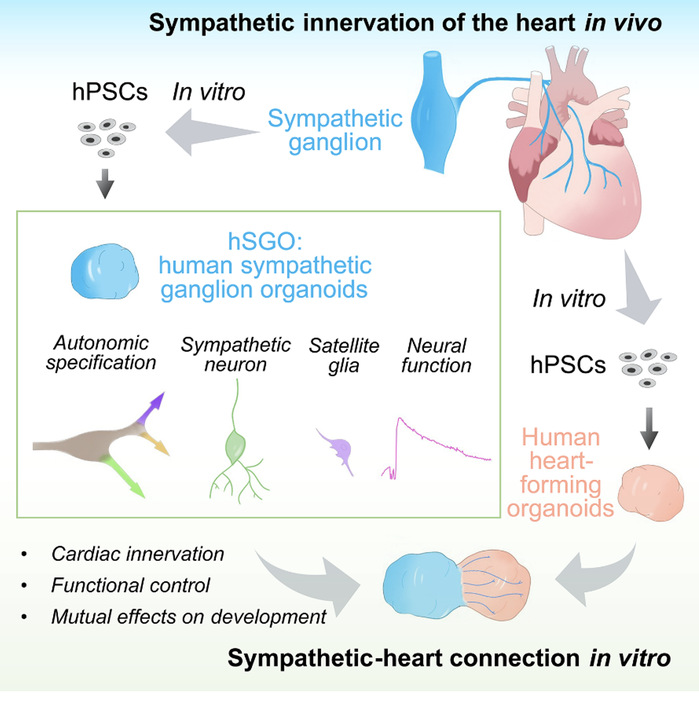
Graphic abstract of the study
Taken together, this study provides a human in vitro model for dissecting sympathetic ganglion biology, neuro–cardiac interactions, and related diseases. Graduate students Liu Yantong, Zhu Jinkui, and Lu Xiaoxiang from Prof. Xiang’s group at the SLST, are co-first authors of this paper, with Prof. Xiang as the corresponding author. ShanghaiTech University is the primary affiliation.