

In the past week, John Collier, director of the UK’s Central Laser Facility (CLF) and executive chair of LaserLab-Europe, and Anne L’Huillier, 2023 Nobel Laureate in Physics and professor at Lund University, were invited to deliver the 29th and 30th editions of the ShanghaiTech Lecture Series.
From the perspectives of instruments and principles respectively, these two scientists outlined the complete picture of optical science—from large-scale support facilities to breakthroughs in frontier physics.
Strategic blueprints for national laser facilities
On the morning of April 16, the head of the UK’s Central Laser Facility (CLF), Professor Collier, delivered a talk titled “The UK’s Central Laser Facility,” systematically introducing the core architecture and strategic layout of the CLF as a cornerstone of British national research infrastructure.
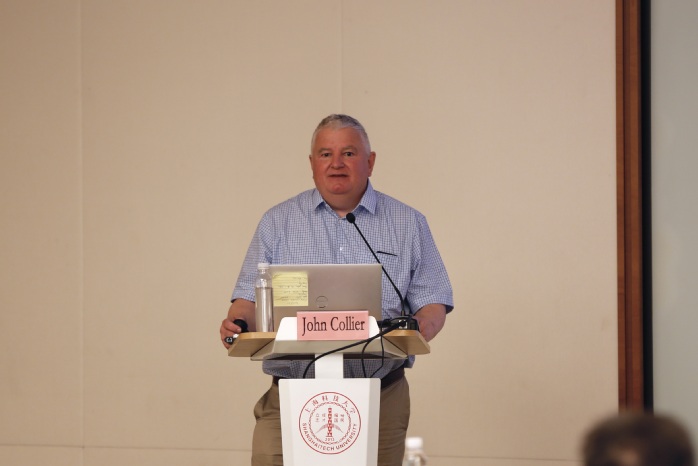
He detailed several key initiatives, including HiLUX, EPAC, UPLiFT, and Vulcan 20-20—a flagship facility undergoing an upgrade to reach a peak power of 20 petawatts. Once it becomes operational in 2029, it will be one of the most powerful lasers in the world.
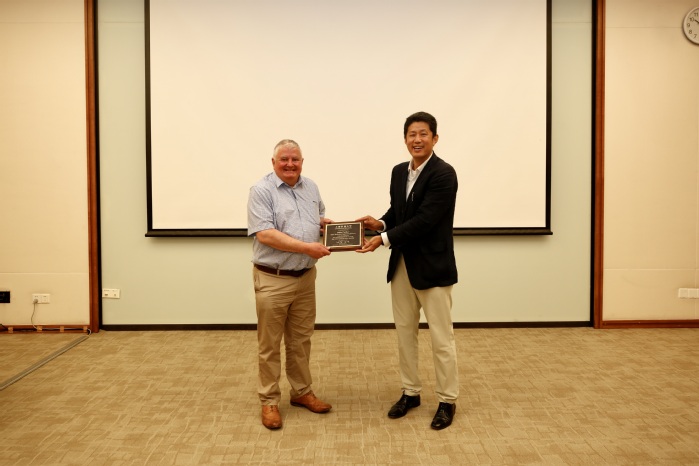
Professor Collier also explained how the CLF integrates platforms like OCTOPUS and ULTRA to provide systematic support for user access and long-term investment within a unified national framework. His presentation demonstrated how national-scale scientific infrastructure drives multi-disciplinary innovation in the U.K. Following the lecture, ShanghaiTech Vice President Liu Zhi presented Professor Collier with the ShanghaiTech Lecture certificate.
The route to attosecond light pulses
The ShanghaiTech Lecture Series hosted 2023 Nobel Laureate in Physics, Professor Anne L’Huillier, on the afternoon of April 19 to deliver a keynote speech titled “The Route to Attosecond Light Pulses,” where she guided the audience into the wondrous world of attosecond science and shared her journey toward the Nobel Prize.
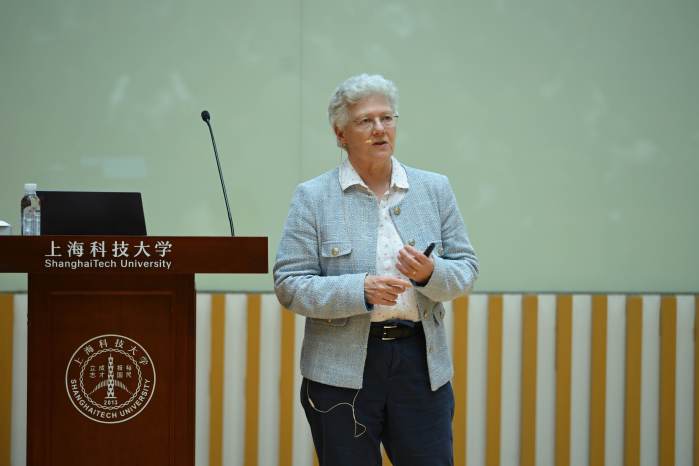
An attosecond (10-18 seconds) is the shortest time scale currently controllable by humans. To observe the movement of electrons at the atomic and molecular levels, one must use ultrashort pulses of light on the attosecond scale.
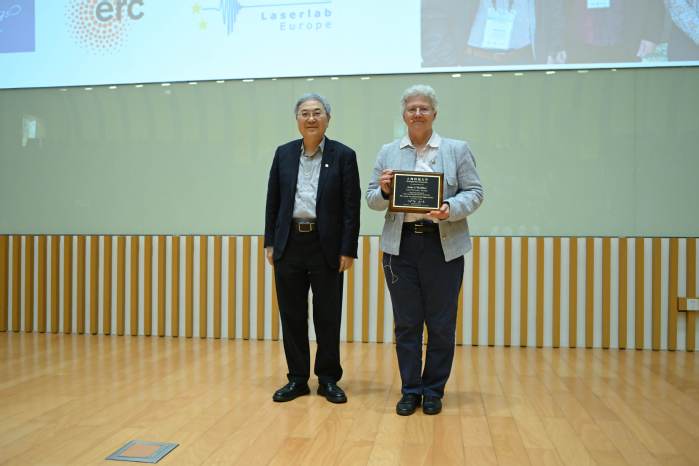
Professor L’Huillier explained the discovery of high-order harmonic generation (HHG) in accessible terms. When an infrared laser shines through a gas, the gas emits “overtones” of extreme ultraviolet light. When these overtones overlap, they form a series of incredibly short attosecond light flashes. This discovery acts like the “flash of an ultra-high-speed camera,” allowing scientists to capture electronic motions that were previously unobservable. After the talk, ShanghaiTech executive vice president and provost, Yin Jie, presented Professor L’Huillier a ShanghaiTech Lecture certificate.
Two sides of optical science
The lectures by Professors Collier and L’Huillier perfectly illustrated the two sides of the same coin in optical science: the strategic construction of large-scale research infrastructure and the revelation of fundamental physical principles in the microscopic world.
The world-class laser facilities and open platforms provided by the CLF offer the indispensable experimental conditions for scientists globally to explore attosecond phenomena. Conversely, the pioneering research by scientists like L’Huillier on HHG and attosecond pulses continuously pushes the boundaries of our understanding of natural laws, which in turn sets higher scientific goals for large-scale laser facilities.
These two closely-timed reports with echoing themes allowed the ShanghaiTech community to appreciate both the strategic vision behind macro-infrastructure in laser science and the captivating beauty of micro-exploration in basic physics. They further underscore the status of the ShanghaiTech Lecture Series as the university’s highest-profile academic platform, dedicated to facilitating dialogue with world-leading scholars and fostering a deep merging of frontier ideas.