Profile of Su Mengjiao ’21
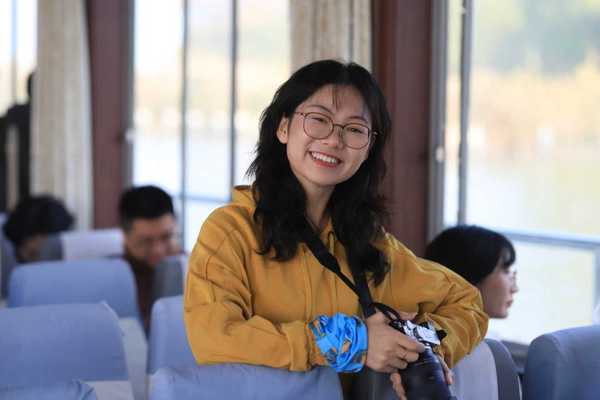
Su is a 2021 graduate student in Chemistry at the School of Physical Science and Technology (SPST), under the supervision of Professor Ji Quanjiang. She focuses on the development of CRISPR-Cas system gene-editing tools and the research of their molecular mechanisms. Her work has been published in top international journals such as Nature Chemical Biology and Microbiology Spectrum. During her studies, she received honors such as the Outstanding Student Award, along with city-level and national-level scholarships.
Encounters with research—from “assembling by blueprint” to “learning to design”
During her undergraduate years at SPST, driven by a simple desire to enrich her university life, Su joined the “Non-coding RNA and Drug Laboratory.” There, she began her exploration of the CRISPR system. At first, she immersed herself in the hands-on joy of experiments, likening them to “building with Lego blocks according to the manual.” It was only when her mentor gently reminded her that “research requires more reflection” that she realized true scientific inquiry goes beyond following blueprints—it demands learning to sketch the unknown maps of discovery. From that moment, Su consciously developed her critical thinking, posing questions from multiple perspectives. It was then that she was truly attracted to the charm of exploring in science.
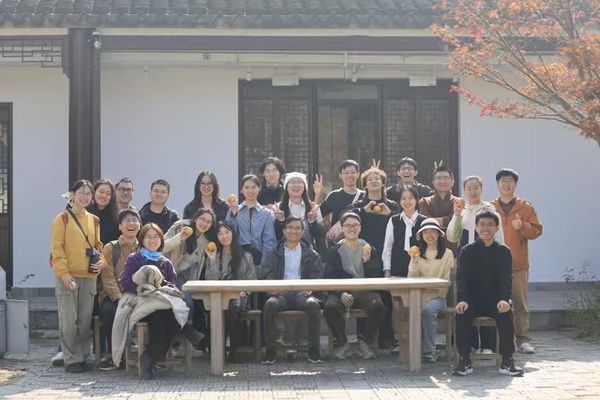
Group photo of the Ji Quanjiang group
In her undergraduate years, Su had attended two academic lectures by Professor Ji. The first introduced the mechanisms of CRISPR-Cas9 and the group’s innovative bacterial gene-editing tools, vividly demonstrating the transformative power of these technologies in tackling real biological challenges. Professor Ji’s evident passion for research deeply inspired her. The second lecture, on the group’s cutting-edge pursuits of miniature CRISPR-Cas systems, left her captivated and, without hesitation, she chose to continue her graduate studies at ShanghaiTech in Professor Ji’s group, steadfastly embarking on the path of gene editing research.
Turning the “impossible” into “possible”
In her graduate study, Su focused on developing miniature CRISPR-Cas12f gene-editing tools, aiming to overcome the clinical bottleneck caused when oversized Cas proteins hinder efficient delivery. Although the group had previously achieved breakthroughs with AsCas12f1, like most existing tools, it was limited to recognizing T-rich sequences. To create a miniature editor with broader targeting range, the team, with sharp academic insight, turned their attention to CnCas12f1, which is capable of recognizing distinctive C-rich sequences.
Yet a formidable challenge emerged. While effective in vitro, the system showed no detectable editing activity in live bacterial cells. Confronted with this “active in test tube, inert in vivo” paradox, Su and her teammates delved into the underlying mechanisms, resolving structures to uncover the reasons. Early attempts at developing the CnCas12f1 tools repeatedly failed. Amid anxiety and self-doubt, a senior lab-mate’s gentle advice, “Take it slow; that’s how you go faster,” helped her calm her mind, abandon haste, and focus meticulously on each step. Eventually, under Professor Ji’s guidance and through team collaboration, Su successfully made significant progress in developing the CnCas12f1 tool.
Advancing through exploration and community service
Nowadays, Su’s research vision has broadened further. These days she explores the microscopic “arms race” between bacteria and viruses, seeking to unearth novel, uncharacterized defense systems and develop next-generation biotechnology tools with clinical potential. She deeply values the academic platforms provided by the university, seizing opportunities at international conferences to engage with leading CRISPR scholars worldwide, continually expanding her scientific horizons.
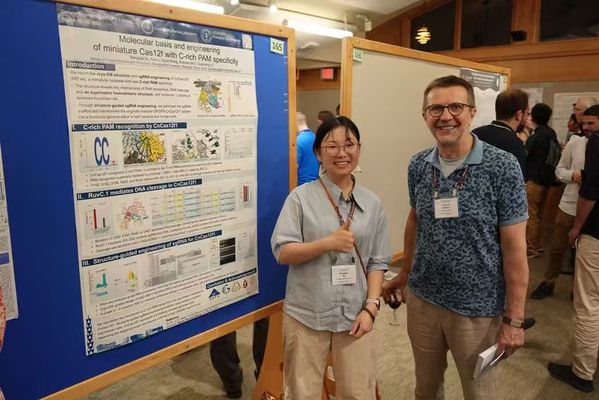
Su attended the “Genome Engineering: CRISPR Frontiers” meeting at Cold Spring Harbor Laboratory, USA.
Beyond the lab, Su embodies community service. For a period during her undergraduate and graduate study years, she served as dormitory floor leader, helping other students, growing herself through helping others.
Her supervisor once told her, “Don’t care too much about others’ opinions—even mine.” These words fueled her courage, in moments of retreat, to take bold steps forward. Looking back, every guiding person stands as a “distant vision” in her heart. Su now gazes toward the future, continuing her pursuit of scientific light amid the vast starry sea of gene editing.