

On February 19, a breakthrough study was published online in Nature in a paper titled “Integrated photonics enabling ultra-wideband fiber–wireless communication.” This work was jointly completed by Associate Professor Chen Baile from the School of Information Science and Technology (SIST) at ShanghaiTech, Professor Wang Xingjun and Assistant Professor Shu Haowen at Peking University, and Professor Yu Shaohua at Peng Cheng Laboratory.
By developing ultra-high-bandwidth integrated photonic devices, the team has overcome the long-standing bandwidth mismatch between fiber communication and its wireless counterpart, enabling efficient transmission over a shared-bandwidth infrastructure. The work demonstrates single-lane data rates of 512 Gbps for short-reach fiber and, for the first time to the authors’ knowledge, 400 Gbps for high-speed wireless transmission.
With the advent of the internet of everything (IoE), future communication networks require not only extremely high single-lane speeds but also seamless convergence between wired fiber networks and wireless access networks. However, a fundamental disparity has persisted for decades—fiber communication offers enormous bandwidth resources, while wireless communication is constrained by limited device bandwidth and system architecture—creating a major bottleneck for 6G, remote healthcare, and large-scale data-center interconnects.
To address this challenge, the team proposed an ultra-wideband (UWB) integrated photonics scheme based on a thin-film lithium niobate (TFLN) modulator and a modified uni-travelling carrier photodiode (UTC-PD). The core innovation lies in the electro–optic (EO) and optic–electro (OE) conversions featuring 3-dB operational bandwidths exceeding 250 GHz for both devices. This enables direct conversion of wideband baseband signals from the fiber domain to the Terahertz (THz) wireless domain without complex intermediate-frequency mixing or additional hardware.
Using the same set of devices and powered by a unified complex bidirectional gated recurrent unit (complex-biGRU) algorithm, the system achieved high-quality data transmission in both fiber and wireless links. Furthermore, an all-optically assisted ultra-broadband wireless scheme enabled high-density access, realizing 86 channel real-time 8K video transmission with 1 GHz channel bandwidth across 138 to 223 GHz—an order of magnitude larger than the standard 5G protocol. The results pave the way for high-throughput, low-latency fiber–wireless convergence in next-generation networks.
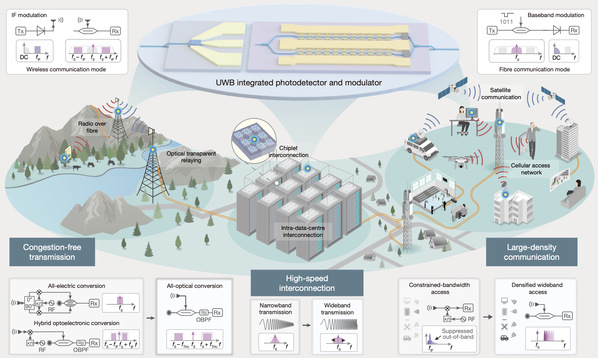
Conceptual drawing of the integrated UWB all-optical telecommunication system, showing congestion-free fiber–wireless transmission, high-speed fiber interconnection, and large-density fiber–wireless access.
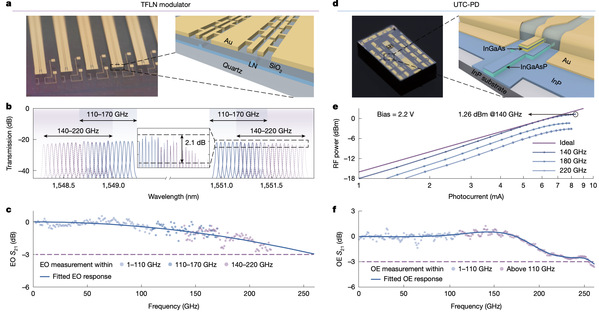
Characterizations of the ultra-broadband modulator/detector and their electro–optic/optic–electro performance.
The co-first authors are Zhang Yunhao (jointly PhD student from Peking University and Peng Cheng Laboratory), Prof. Shu Wenhao, Guo Yijun (PhD student at Peking University), Zhou Peiqi (Senior Engineer at the National Information Optoelectronics Innovation Center), and Wang Luyu (SIST PhD student). The co-corresponding authors are Prof. Wang Xingjun, Prof. Yu Shaohua, Prof. Chen Baile, and Prof. Shu Wenhao.