
Brain-computer interfaces, superconducting quantum systems, CAR-T cell therapy, and viral structures highlight the breadth of research explored in four lectures
This autumn, the ShanghaiTech Lecture series brought four leading scientists from different fields to campus: a pioneer of brain-computer interface research, a physicist exploring quantum systems near absolute zero, a pioneer of CAR-T cell therapy, and a structural biologist studying viruses. Their subjects could hardly be more different. Yet the four talks shared a common impulse: pushing the boundaries of what we can understand, measure, and treat.
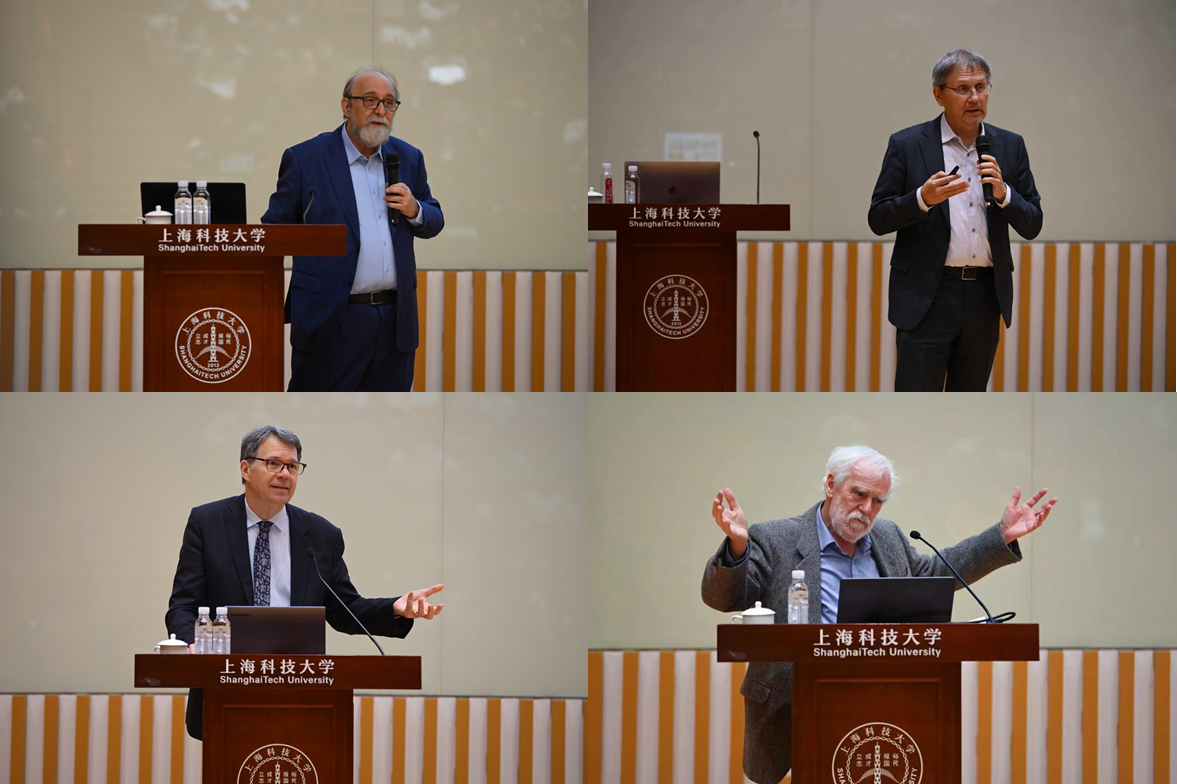 Top row, from left: Miguel Nicolelis and Oleg Astafiev; bottom row, from left: Michel Sadelain and Sir David Stuart
On October 27, Professor Miguel Nicolelis opened the series with a lecture on brain-computer interfaces (BMI). A foreign member of the French Academy of Sciences and a member of the Brazilian Academy of Sciences, Nicolelis traced the field’s development from basic scientific discoveries to clinical applications. He focused on the Walk Again Project, which combines non-invasive BMI with robotics and virtual reality. The project has helped patients with chronic spinal cord injuries regain motor function, and is the only BMI-based therapeutic protocol to date to have been validated through multinational clinical trials. Nicolelis also discussed the technology’s potential applications in treating Parkinson’s disease, epilepsy, stroke, and Alzheimer’s disease. He emphasized that advances in the field should be safe, effective, affordable, and scalable.
“A real breakthrough is not just a paper in a top journal, but getting past the walls of the lab to address ordinary people’s hopes for better health,” a ShanghaiTech doctoral student said after the lecture.
On October 29, Oleg Astafiev, a professor at Russia’s Skolkovo Institute of Science and Technology, turned to the quantum world in a lecture titled “Superconducting Quantum Systems: From Quantum Optics to Quantum Metrology.” He showed how superconducting circuits can be integrated with quantum optics. At temperatures approaching absolute zero, researchers can manipulate quantum states with extraordinary precision. Such control is important for the development of quantum computing and high-precision quantum metrology.
The third lecture, on November 9, featured Professor Michel Sadelain of Columbia University, a pioneer of CAR-T cell therapy. In a talk titled “The Origins and Evolution of Chimeric Antigen Receptors (CARs),” he traced the development of the therapy from an early scientific concept to clinical treatment. By genetically engineering patients’ own T cells to recognize and attack cancer cells, CAR-T therapy has transformed the treatment of blood cancers. A graduate student working in cell therapy described the talk as an inspiring account of scientific progress and a reminder of the patience required to bring new ideas into clinical practice.
On November 15, Sir David Stuart, a Fellow of the Royal Society and professor of structural biology at the University of Oxford, delivered the fourth lecture, titled “How Structural Analysis Has Changed Our Understanding of the Viral World.” He explained how structural biology has advanced our understanding of viruses. By resolving the three-dimensional structures of viral proteins, scientists can identify vulnerable points that may be targeted by vaccines and antiviral drugs. These advances have accelerated the development of new treatments and helped reshape approaches to preventing and responding to infectious disease outbreaks.
Together, the four lectures spanned neuroscience, physics, cell therapy, and structural biology. What connected them was not their subject matter, but a shared approach to scientific inquiry: curiosity about the unknown, a willingness to challenge existing limits, and a commitment to making discoveries useful beyond the laboratory.
“Whether it is a superconducting circuit near absolute zero or a cellular mechanism in life science, we are all looking for the underlying logic of how nature works—and that search across disciplines is what makes this fascinating,” said a young faculty member researching quantum materials.