

ShanghaiTech’s first TECHATHON draws 150 students
Can finding an object in a video be as simple as searching text? Can a single photo turn an item into an adjustable digital object in 3D space? Can a locker track what goes in and out using just a camera and a voice interface?
At TECHATHON, ShanghaiTech’s first-ever hackathon, held in the Conference Center West Hall from October 16 to 18, these questions did not remain hypothetical. Forty-three teams turned them into working prototypes.
The topics were entirely open. Campus life, AI applications, software tools, interactive experiences, and smart hardware, students started with problems they identified firsthand and faced one practical question above all: How do you turn an idea into something that works, can be demonstrated, and stands up to scrutiny?
Across the hall, some students were busy writing code and debugging interface. Others gathered around prototype boards and electronic components, tracing faults. A few worked 3D printers to fabricate hardware parts. Teams moved between development, testing, discussion, and revision as their initial sketches gradually took shape.
Throughout the event, students used AI not only in their projects but also throughout the development process, from AI-assisted programming and digital asset generation to design exploration. With AI tools, teams could explore implementation paths that would have been out of reach otherwise. For many, the real test was not whether they could use AI. It was whether they could make AI work inside a system that had to actually run.
The event was jointly organized by two student clubs, GeekPie_ and T.I.E Tech Entrepreneurship Club, with support from Kedao College, the School of Entrepreneurship and Management (SEM), and ShanghaiTech’s incubator.
The two student clubs built the event from scratch. They conceived the hackathon, designed the competition format and schedule, produced all visual materials, set up the submission process, recruited judges, and coordinated on-site operations.
The clubs also developed their own countdown display and scoring system. In this sense, the students were not only building projects for the hackathon; they were also using their technical skills to build the tools that made the event possible.
After the 48-hour hackathon, judges toured the West Hall on October 18, examining the submissions and asking teams about the problems they sought to solve, their technical approaches, and the user experience. Shortlisted teams had five minutes to demonstrate what they had built in those 48 hours—from lines of code and models to interfaces and hardware prototypes.
Although the event was a hackathon, not all the winning projects focused on AI. The first-prize winner, ObjectTalk Team, turned English speaking practice into a two-player cooperative game. Players take on different roles, each with different information, and must communicate to complete tasks in a 3D environment. Rather than relying on scripted drills, the game gives players a genuine reason to speak and work together.
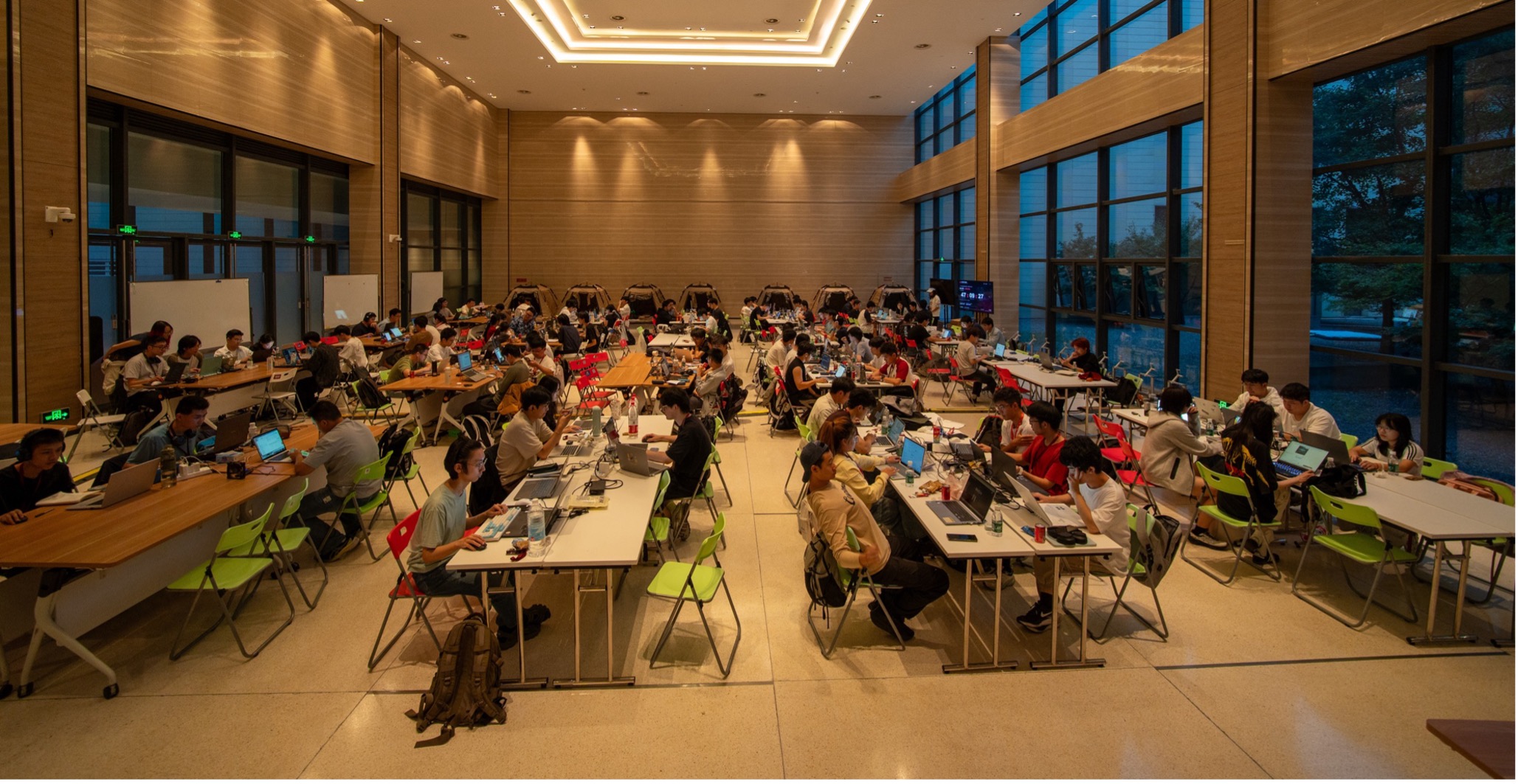 Teams work late into the night at the Conference Center West Hall during the 48-hour hackathon.
When the 48 hours ended, what remained was more than a list of winners. Participants came away with a deeper understanding of how to turn technical ideas into viable products by solving real-world problems.
From identifying a problem and designing a solution to building a prototype and presenting it to judges, TECHATHON 2026 gave students an opportunity to put their knowledge into practice, collaborate across disciplines, and experience the challenges of turning an idea into a working product.