

SCA students explore the festival’s theme “Negotiating Humanity” through five interactive installations
 SCA students and faculty pose for a photo at the JKU MED Campus.
ShanghaiTech students returned to the Ars Electronica Festival this September with “Negotiated Realities”—an exhibition of five techno-art installations that ask a single, unsettling question: in an age when algorithms mediate our relationships, decisions, and desires, how is technology changing what it means to be human?
The exhibition, presented at the JKU MED Campus as part of the festival’s Campus Exhibition, marked ShanghaiTech’s return to Ars Electronica for another year. Media art critics and festivalgoers responded strongly to the works, with many describing the ensemble as a visual poem that brings together cold technological precision with organic, biological beauty.
Founded in 1979, Ars Electronica is widely regarded as one of the world’s leading festivals at the intersection of art, technology, and society. The 2026 edition, held from September 9 to 13 in Linz, Austria, took “Negotiating Humanity” as its theme—a focus on the ever-evolving relationship between human and technology.
Organized by ShanghaiTech’s School of Creativity and Art (SCA), “Negotiated Realities” explores how technology shapes human perception, behavior, and decision-making. Rather than treating technology simply as a tool, the five works examine how it becomes intertwined with everyday life. Visitors also play an active role in the exhibition, with their interactions shaping how the works unfold.
Among the five works, “Cupid Proxy” drew particular attention for the uncomfortable intimacy of its premise: a supermarket checkout where romantic communication can be purchased as a service.
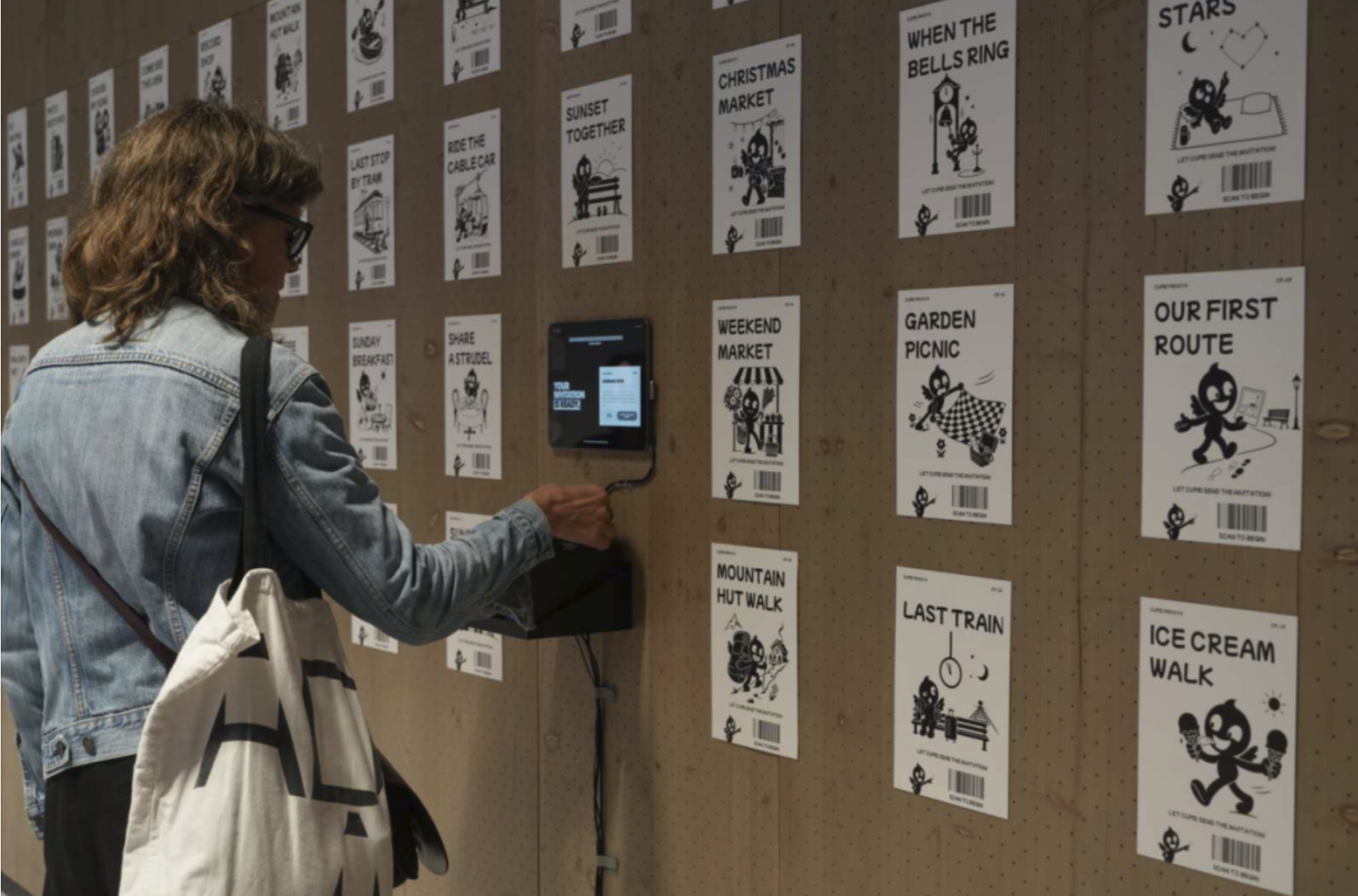 Visitors select and scan a card, as if purchasing a service at an intimacy supermarket.
Created by the Center for Adaptive System Engineering (CASE) at SCA, the installation stages a retail counter at which visitors can buy a love letter, select a gift, plan an anniversary, or have AI deliver an apology—each transaction printed as a receipt that names exactly what has been traded: intimacy gained, agency spent.
The work brings the festival’s theme of negotiation into the realm of personal relationships. When AI helps us express feelings or communicate with someone we care about, does it bring us closer—or diminish our own role in the relationship? The installation asks not whether technology can perform emotional tasks, but what we give up when we let it do so.
The remaining four installations approached the human-machine negotiation from different angles, together forming what the exhibition text describes as “a non-linear ecology” in which no single work delivers a final answer.
“The Neo-Urban Reef”, created by SCA’s DIV Lab in collaboration with the arc/sec Lab, is a mixed-reality installation built around an undulating three-dimensional lattice structure that conceptualizes the city as a fluid living system. Combining physical structures with digital imagery, it reimagines the city as a fluid, modular living system that responds to digital information. Through VR headsets, visitors can explore digital representations of urban structures. The installation envisions a near future shaped by these “new genes,” in which algorithmic code and human agency are so tightly entwined that neither can be disentangled from the other.
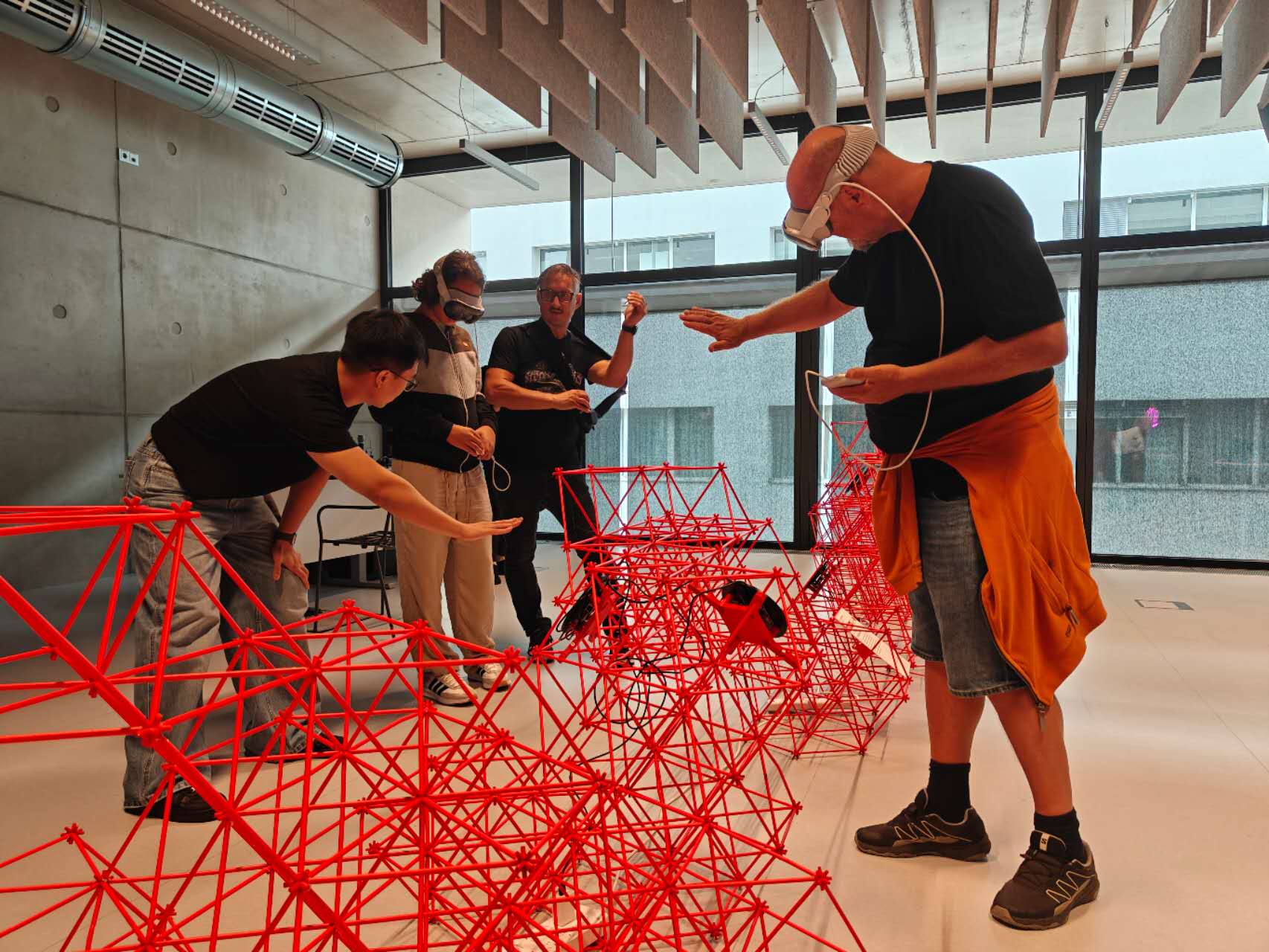 A visitor interacts with digital imagery through a VR headset in front of the installation’s red lattice structure.
“C/Si: TheHumanityTrack”, by CASE, takes the form of an interactive endless-runner game that spans five decades of technological milestones, from 1979 to 2026. Players choose whether to collect products representing emerging technologies from each year as rewards. The work invites visitors to consider a question: as technology expands our capabilities, how can we retain the freedom to act for ourselves and make our own choices while using technology to move forward?
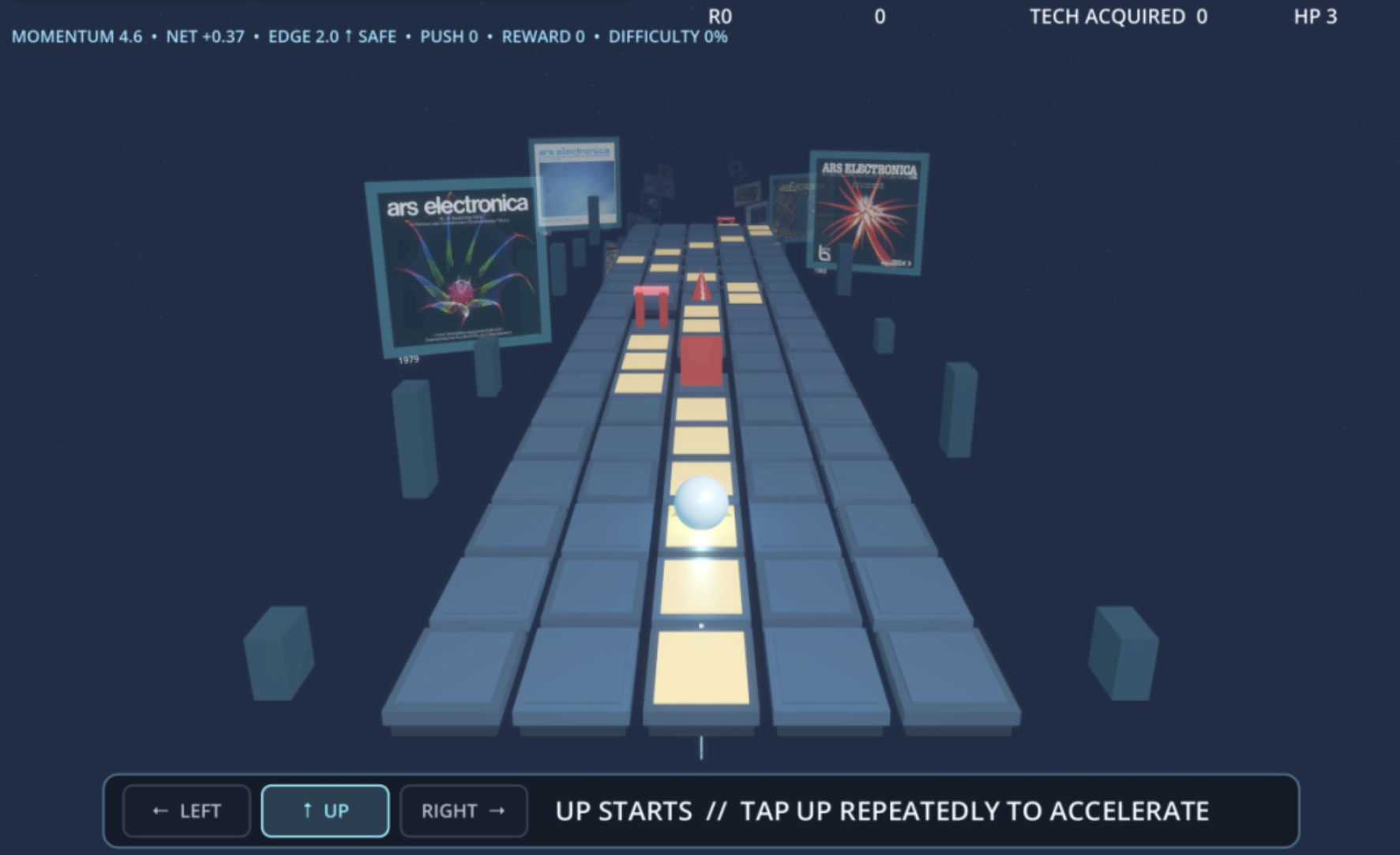 A screenshot of the endless-runner game.
“The Bias of Creation: Embodied Aesthetic Negotiation,” by CASE, invites visitors to co-design an urban space with an AI-driven robotic arm. Using colored blocks to represent different types of urban spaces, such as residential areas, rivers, commercial districts, and landscapes, visitors negotiate with the robotic arm over the layout. The arm responds based on the existing layout and the available blocks. When an aesthetic consensus is reached, it physically grasps, adjusts, and places the blocks to propose its own vision. The work asks: when a robot begins to participate in our creation and judgment, is it deciding for us—or are we forming new possibilities together?
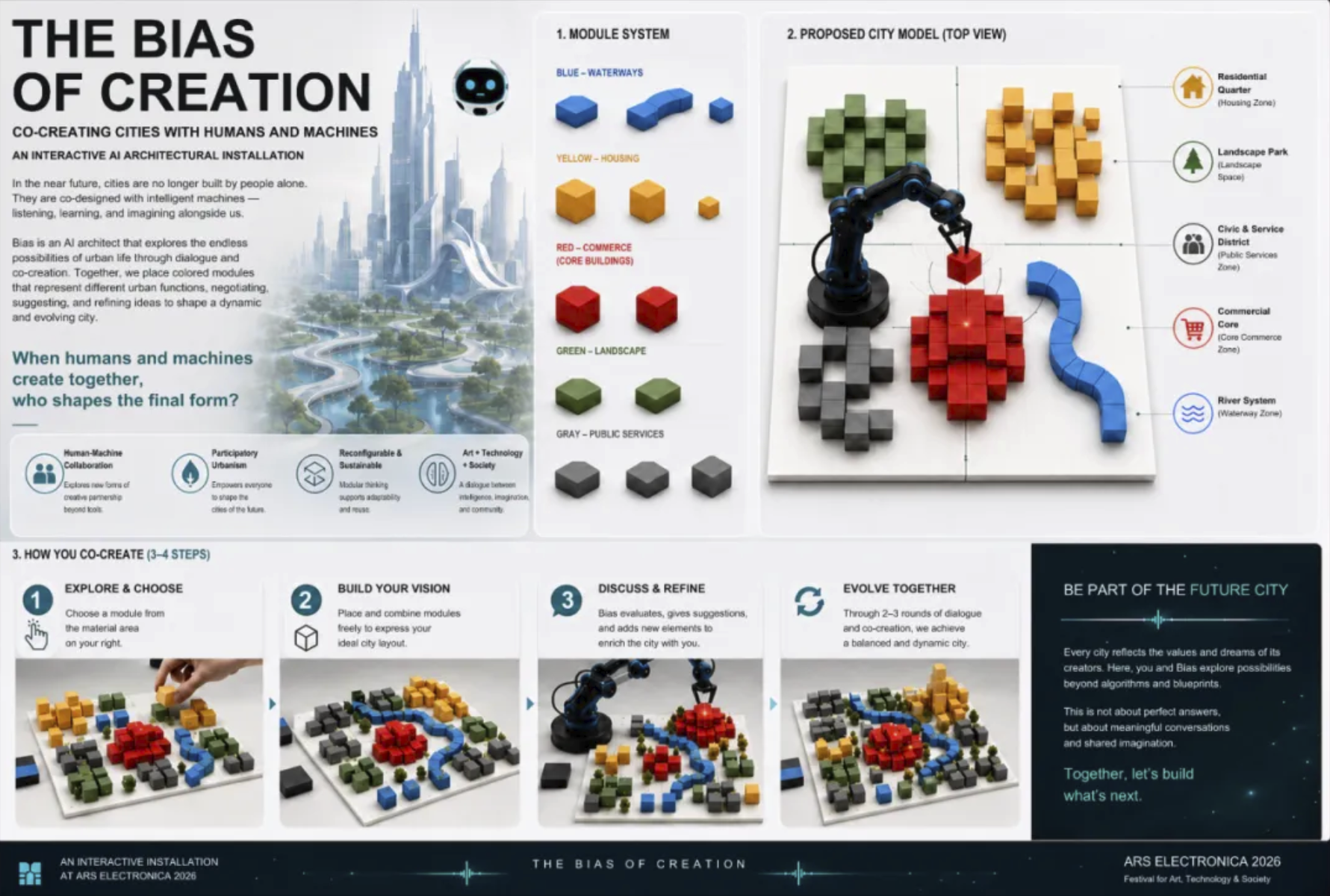 A poster introducing the installation and explaining how visitors can interact with the robotic arm.
“Neural Negotiating,” a cross-disciplinary collaboration between SCA’s DIV Lab and the BioMed I2 Lab at ShanghaiTech’s School of Biomedical Engineering, makes neural activity materially visible. Visitors encounter a taste stimulus while wearing an EEG cap; their real-time brainwave data animates a multi-layer fiber-optic embroidered sculpture, with color, brightness, rhythm, and depth emerging from the signals to form a luminous neural cloud. The work does not merely visualize brain data—it materializes a temporary trace of perception that normally remains invisible.
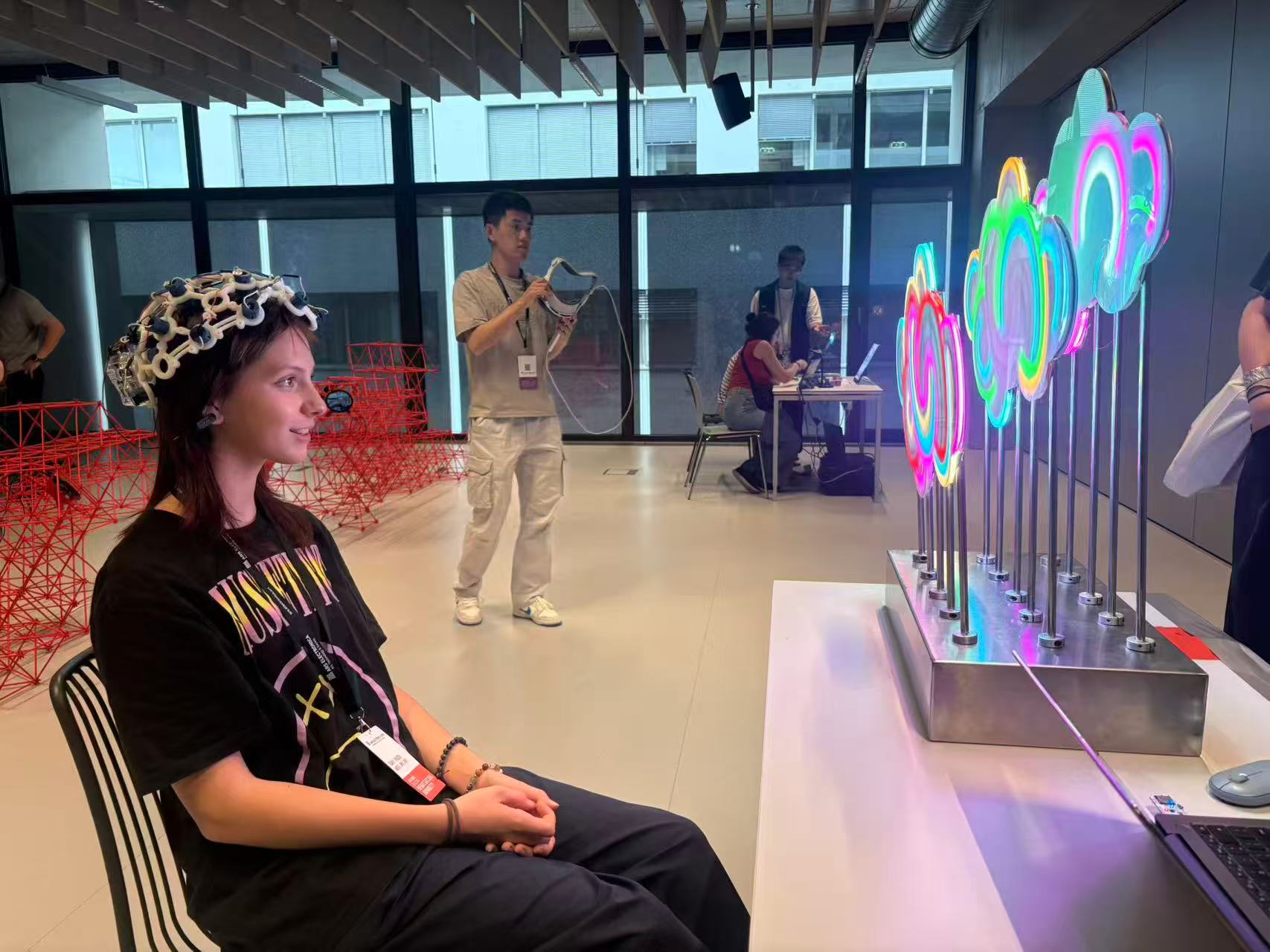 A visitor wearing an EEG cap experiences the colorful visual effects of Neural Negotiating.
Reflecting on the experience, Yang Hua and Wu Yingna, assistant deans of SCA, highlighted the human questions at the heart of techno-art.
“Techno-art is both joyful and serious. Its appeal lies in standing at a threshold: one step forward brings ecstasy, one step back, longing. It gives us tools of the gods, yet asks us to bear their weight with a human heart,” Yang said. She added that the students’ work went beyond artistic and technical achievement, encouraging them to critically examine the boundaries between humans and technology.
Wu reflected on how the festival brought student installations into everyday urban spaces, moving beyond technology for technology’s sake. “As a mentor with a technical background, I initially focused on whether the programs would run reliably. But conversations with creators from around the world about AI ethics and human–machine coexistence reminded me that technology and art are not ends in themselves. They are means of expression and connection, with people at the center.”