
ShanghaiTech’s School of Creativity and Art brings Chinese and Norwegian students together to develop industry-oriented design solutions showcased at WDCC 2026.

Participants in the WDCC forum.
Held along the Huangpu River in late September, the 2026 World Design Cities Conference (WDCC), co-hosted by the Shanghai Municipal People’s Government and UNESCO, brought together designers and industry leaders under the theme “Design Everywhere in the City, Design Everywhere in Life.” This year’s WDCC explored how design can drive industrial development and enrich urban life. The School of Creativity and Art (SCA) at ShanghaiTech University took an active role and organized a high-level forum and an intercultural workshop.
International forum explores the frontiers of ritual design
The forum, jointly organized by SCA, firefly, NIO’s electric vehicle brand, and the Oslo School of Architecture and Design (AHO), focused on how ritual design can contribute to a smarter and higher-quality way of life. Ritual design uses design to turn everyday activities into meaningful experiences by connecting actions, emotions, and technology. Moderated by Yang Jidong, vice dean of SCA, the forum gathered together experts, scholars, and young participants from China, Norway, and the United States for an interdisciplinary and cross-cultural discussion. They explored how ritual design can be applied to intelligent mobility, health and care, sports and culture, artificial intelligence, and other fields. The forum was also part of ShanghaiTech’s 2026 Culture and Arts Season.
 Participants gather around a firefly vehicle at WDCC 2026.
In his opening remarks, Yang described ritual design as an emerging interdisciplinary field that integrates experience design, anthropology, and psychology. By embedding emotional meaning and memory into interactions, he noted, ritual design can make technology more human-centered. “The forum offered a platform for international dialogue among academia and industry, bringing Eastern and Western perspectives into conversation. It also provided opportunities to explore how technology and the humanities can be integrated through ritual design, while opening up new possibilities for Chinese and Norwegian faculty and students to test ideas in real-world settings and translate them into industrial applications,” Yang added.
“New possibilities opened up for Chinese and Norwegian designers.”
Speakers approached ritual design from a range of academic and industrial perspectives. Zou Yue, assistant professor at SCA, examined how rituals might be reimagined in the relationship between humans and nature in the age of AI, drawing on posthumanist perspectives. Jin Ge, senior vice president of NIO and president of firefly, shared insights into incorporating ritual design into urban mobility and brand experiences. Other speakers included Ted Matthews, chair of service design at AHO; Weston Baxter, associate professor at the Dyson School of Design Engineering at Imperial College London; and Kajal Khanna, clinical associate professor of emergency medicine at Stanford University School of Medicine. Together, they presented emerging theories and innovative methods for applying ritual design in both research and industry.
Intercultural workshop turns ideas into designs for everyday mobility
While the forum fostered an exchange of ideas, the outcomes of the intercultural workshop, showcased in the main WDCC exhibition, demonstrated how these ideas could be translated into tangible design proposals.
The workshop was an important practical initiative in SCA’s efforts to develop international curricula and strengthen collaboration among academia, industry, and research. Students from SCA and AHO formed joint design teams and spent four immersive days exploring real-world mobility scenarios involving NIO firefly. Their goal was to translate the principles of ritual design for intelligent living into innovative solutions that people could experience and use in everyday life.
Experts who participating in the forum mentored the students throughout the workshop. They guided them in examining the underlying logic of ritual design and analyzing the sequences of activities, human behaviors, emotional experiences, and contextual value associated with different mobility scenarios. This process encouraged students to develop design approaches that integrate humanistic considerations with technology in real-world industrial contexts.
Students were divided into five mixed teams, each focusing on one of five key stages of a trip—departure, driving, companionship, recharging, and arrival. Through an iterative process of ideation, scenario exploration, hands-on testing, feedback, and refinement, the teams drew on their diverse cultural backgrounds and disciplinary strengths to identify users’ core needs and explore how ritual design could enhance everyday mobility.
On the first day of the workshop, Frida Kracht Ur, consul at the Royal Norwegian Consulate General in Shanghai, and Ge Lingfei, public diplomacy advisor, visited the workshop alongside Wang Shouzhi, professor at SCA. They met with students and exchanged ideas, broadening their perspectives on intercultural collaboration.
 Frida Kracht Ur (fourth from left) and Wang Shouzhi (third from right) pose at the front of one firefly vehicle with other participants during the workshop.
The workshop also included a visit to a NIO House in Shanghai. Through discussions about the brand, hands-on product experiences, and test drives, students gained a deeper understanding of firefly’s product concept and real-world usage scenarios. Designers from firefly gave presentations on product definition, user experience, and design implementation, and answered students’ questions during the test-drive and product-experience sessions. These exchanges provided practical guidance grounded in industry experience.
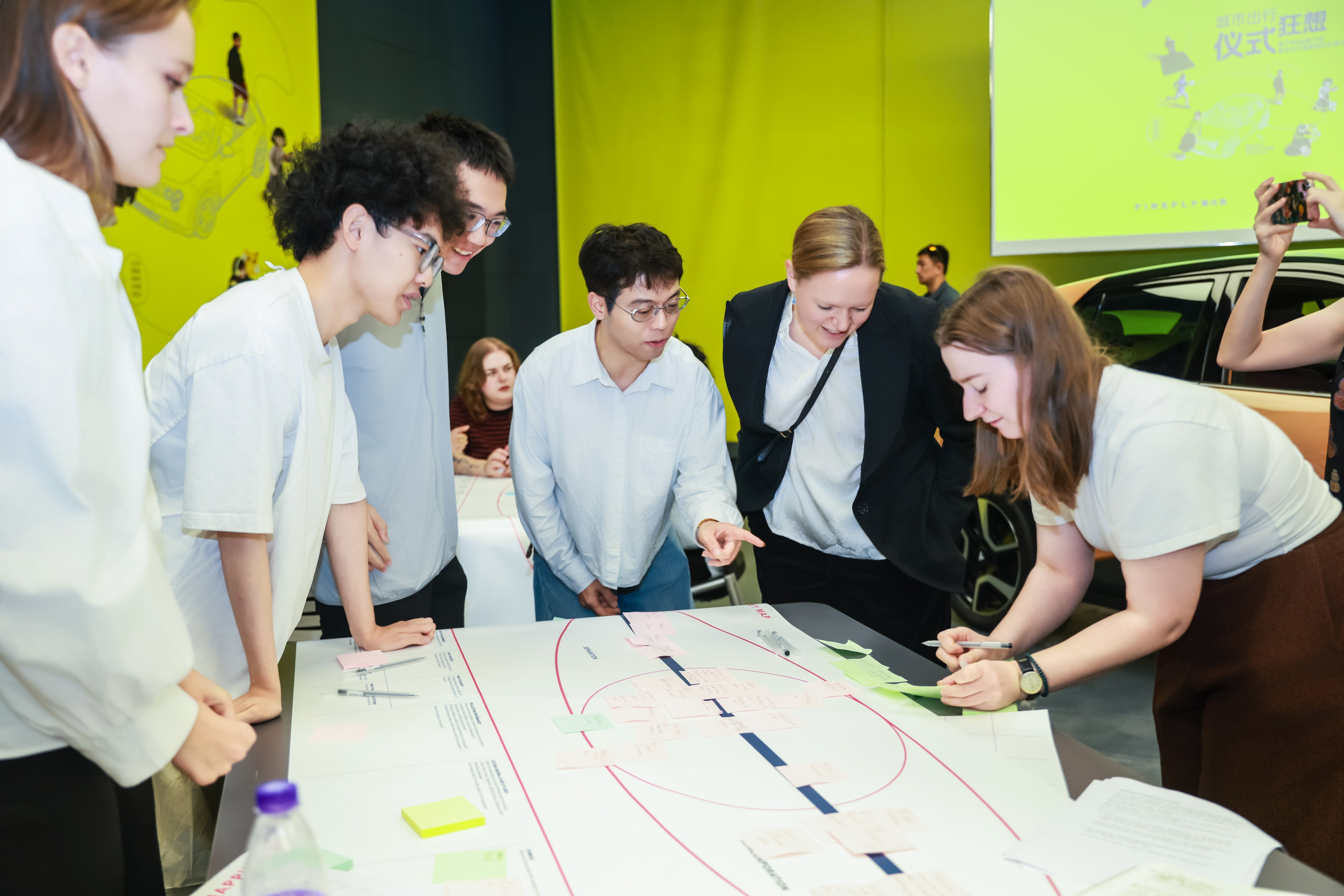 One of the student teams discussing their ideas for ritual design.
The close engagement with industry helped students move beyond the conventional approach of simply adding features to a car. Instead, they learned to consider mobility from the user’s perspective, focusing on people’s experiences and emotional shifts throughout an entire journey. This human-centered perspective lies at the heart of ritual design and helped the teams identify promising directions for their projects.
Student projects
1. Departure team
Project: Safe & Sound
Team members: Dang Yuexin, Wang Jiumo, Maria, Christine, Liu Yifei
The project reimagines the conventional seat belt alert as an interactive ritual. A virtual avatar in the user interface encourages passengers to fasten their seat belts, making safety reminders gentler and more engaging.

2. Driving team
Project: Sparkle—A Light-Based Social Interaction System for firefly
Team members: Tang Qinyu, Zhang Dong, Heidi, Shen Yaqing
The project turns customizable vehicle lighting into a digital identity for firefly owners. When they encounter one another on the road, they can interact silently through their lights, transforming chance encounters into lightweight social connections.

3. Companionship team
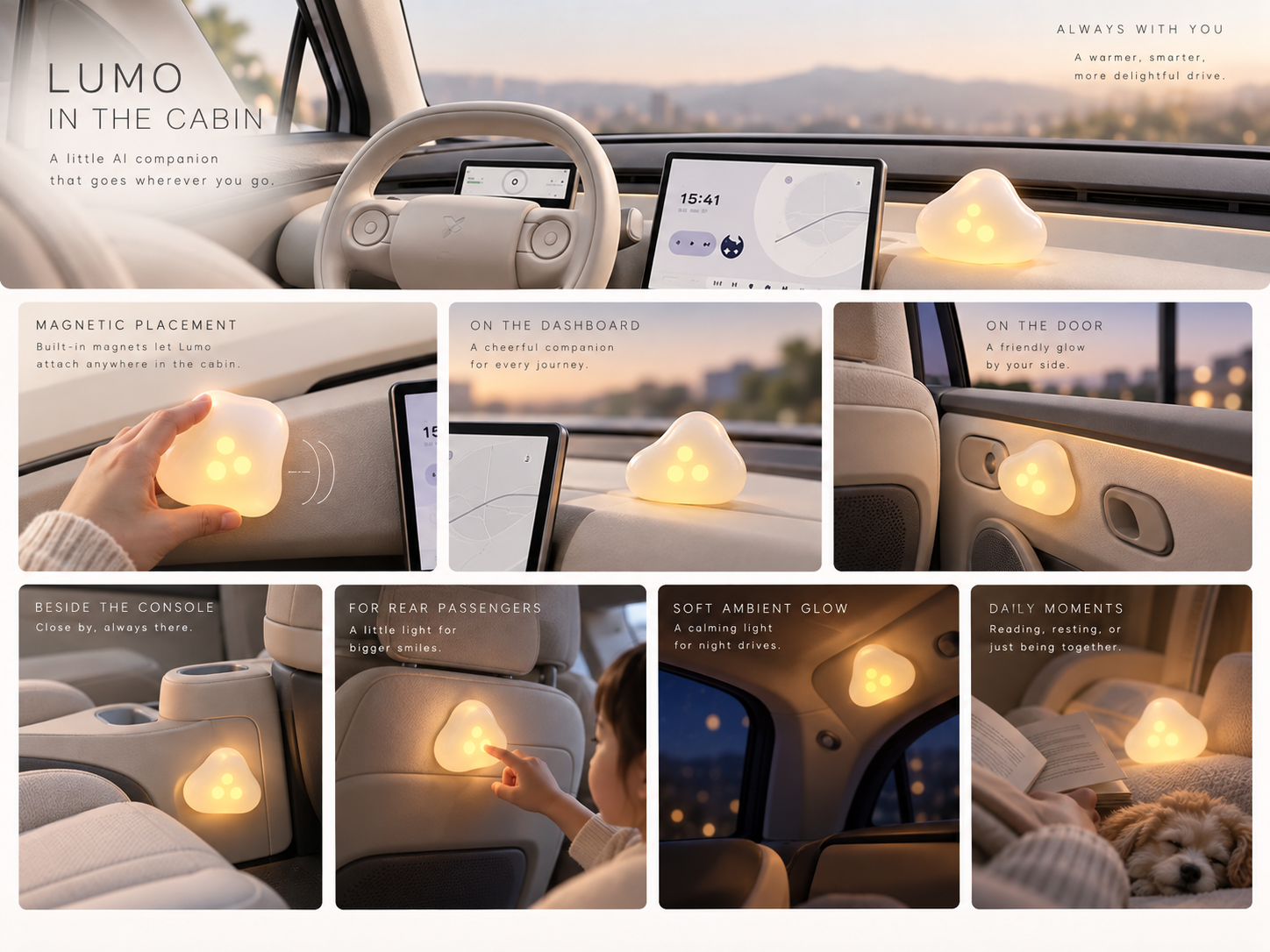
Project: New Lumo New Me
Team members: Zhang Jinshu, Gu Yiming, Ask, Anna
The project envisions a companion-style physical AI for firefly. Through a “hatching” ritual, users begin a new journey with their vehicle, while the AI companion adopts an adaptable form that accompanies them across in-car and out-of-car settings.
4. Recharging team
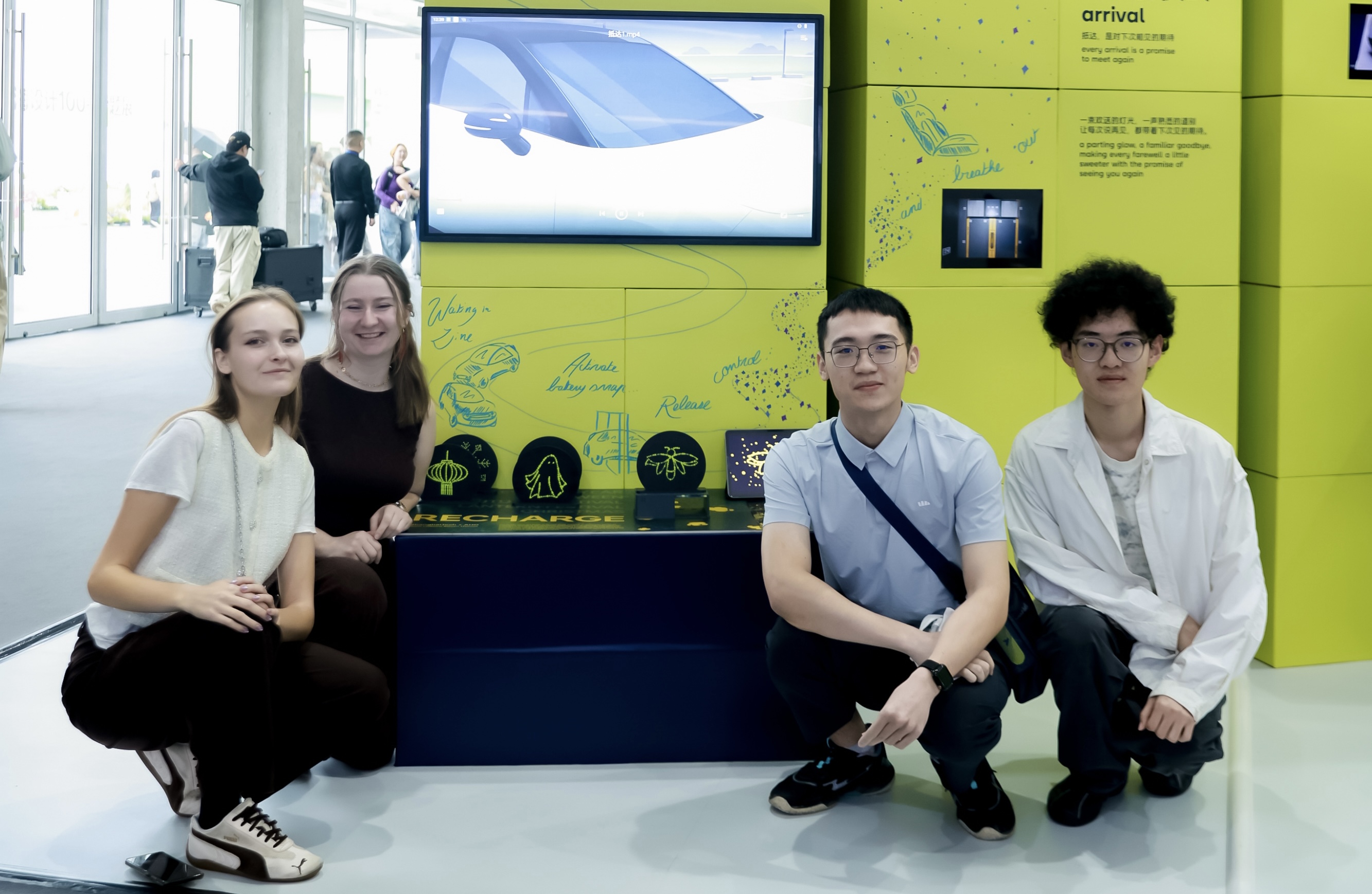
Project: Recharge
Team members: Niu Yiyi, Lu Yixuan, Anne, Ludivine
Inspired by the firefly, the project combines animation, lighting, music, and seat massage to create an immersive recharging experience. It aims to make routine battery swapping feel more meaningful through a multisensory ritual.
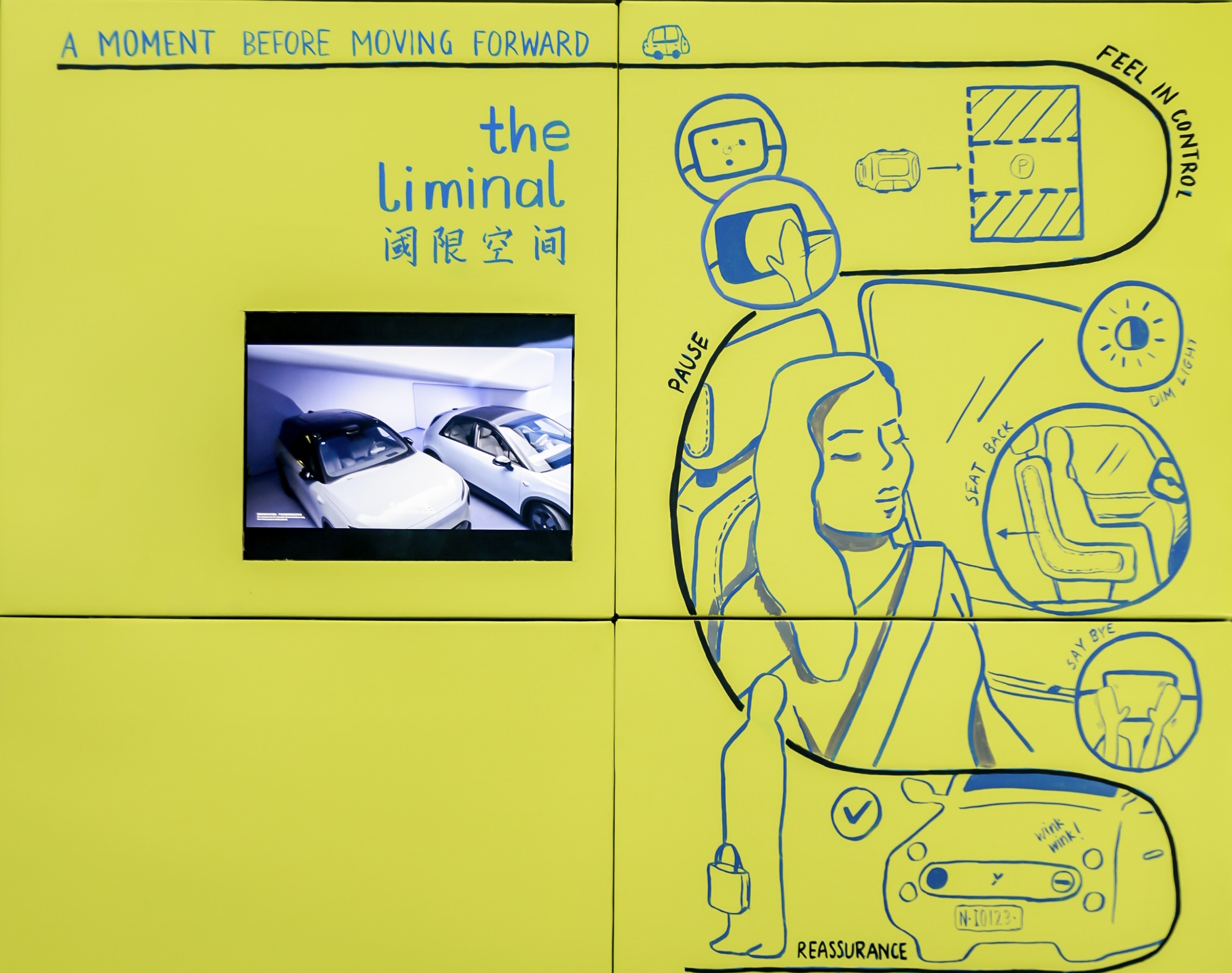
5. Arrival team
Project: The Liminal
Team members: Zhang Cheng, Zhou Ziyu, Aadya, Liv, Roksana
The project transforms arrival into a transition ritual from driving to relaxation. Through gesture-based interactions and interface design, it helps users naturally shift out of driving mode and settle into a more relaxed state.