

Two PNAS studies reveal how CTP synthase coordinates catalysis through conformational change and GTP cycling
CTP is an essential precursor for RNA, DNA, and phospholipid synthesis. CTPS, the enzyme responsible for de novo CTP synthesis, connects two functional domains inside the cell: an N-terminal amidoligase domain that phosphorylates UTP to form the labile intermediate 4Pi-UTP, and a C-terminal glutamine amidotransferase domain that delivers ammonia through an internal tunnel. GTP has long been described as an “allosteric activator,” yet it does not power the reaction by hydrolysis—and until now, no one had clearly seen how it fits into the enzyme’s working cycle.
A team led by Professor Liu Ji-Long at ShanghaiTech University has published two back-to-back papers in Proceedings of the National Academy of Sciences (PNAS) that rethink how one of the cell’s key metabolic enzymes, CTP synthase (CTPS), actually works—not as a static molecular machine, but as a dynamically gated system driven by continuous conformational change.
From frozen structures to a moving picture
The first paper, “Reaction-based cryo-EM resolves the continuous conformational spectrum of CTP synthase catalysis,” introduces a method the team calls reaction-based cryo-EM (Figure 1). Instead of trapping CTPS with inhibitors or non-reactive analogues, the researchers prepare samples at defined reaction stages—pre-reaction, ongoing reaction, and equilibrium—and use 3D variability analysis to resolve a continuum of conformations from a single reaction mixture.
The approach directly visualizes 4Pi-UTP formation and reveals an ATP/CTP co-occupied state that conventional product-soaking structures had missed. Control experiments with non-hydrolyzable ATP analogues show that what drives CTPS toward its closed, catalytically competent state is not merely ATP binding, but the chemical act of phosphorylating UTP.
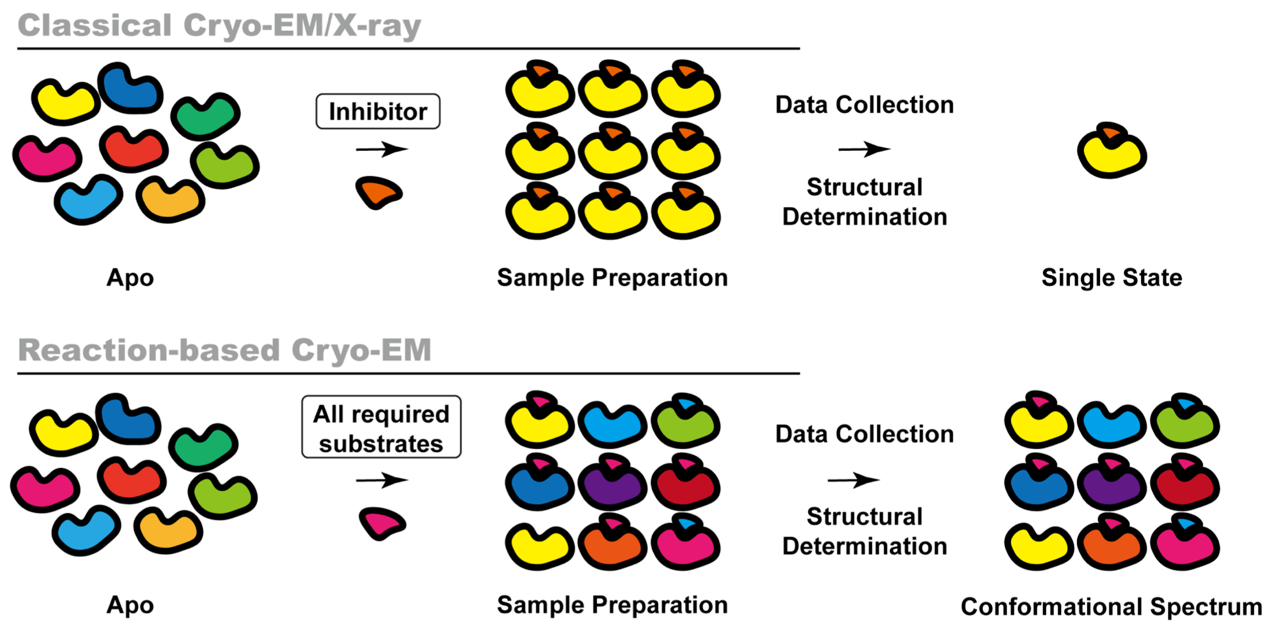 Figure 1. Comparisons between classical cryo-EM/X-ray and reaction-based cryo-EM.
GTP as a catalytic clock, not an on/off switch
The second paper, “GTP orchestrates CTP synthase via an allosteric effector-cycling mechanism,” builds on that conformational map to propose a new principle—effector cycling (Figure 2). Across 34 structural states—reaching up to 2.0 Å local resolution—the team shows that GTP binds and dissociates once per catalytic round:
GTP dissociation opens the enzyme for substrate entry.
Formation of 4Pi-UTP remodels the GAT domain and licenses GTP rebinding.
GTP binding helps assemble the ammonia tunnel and align catalytic residues.
CTP formation is followed by a return to the open state and GTP dissociation.
GTP is therefore not a static switch but a timing device—a non-hydrolytic effector whose binding and dissociation kinetics coordinate chemistry between the two domains. The GTP-binding pocket is highly conserved across bacteria, archaea, and eukaryotes, suggesting that effector cycling is an ancient mode of metabolic regulation.
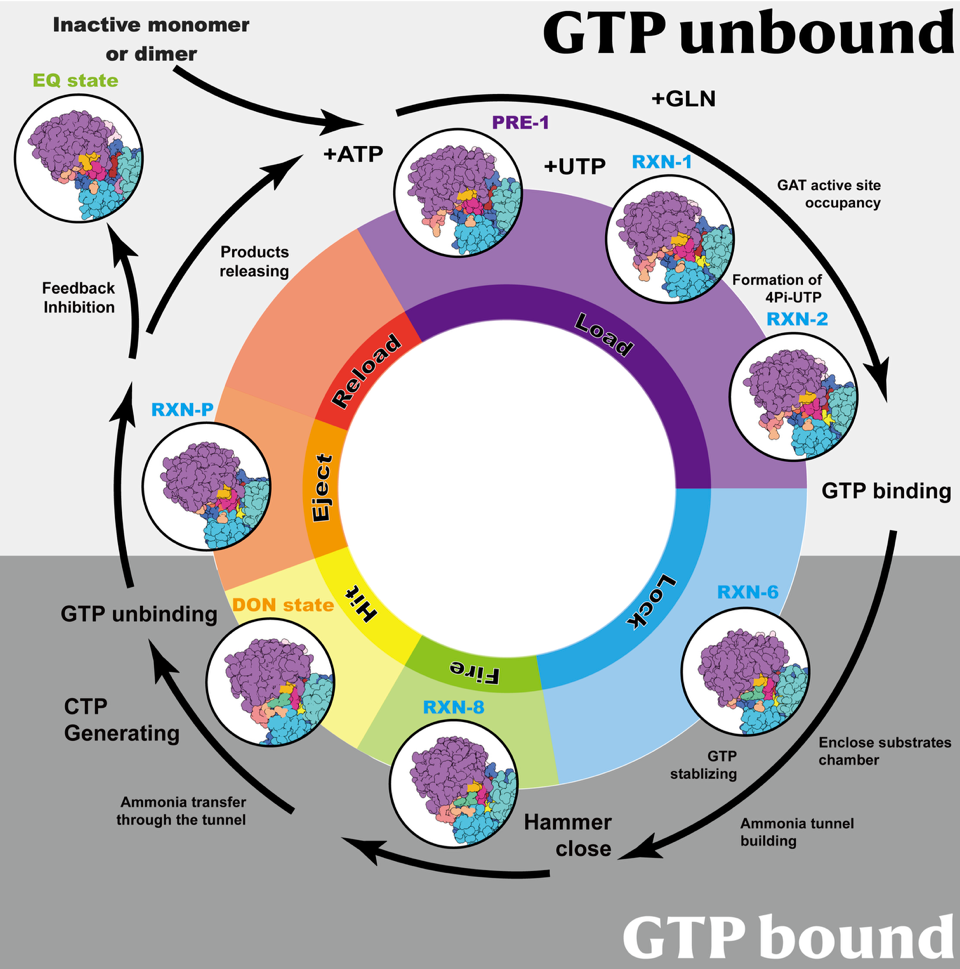 Figure 2. Cycling of GTP during CTPS catalysis.
Professor Liu first observed CTPS assembling into filament-like intracellular structures—later named cytoophidia—in 2007 at the University of Oxford, and formalized the concept in 2010. After joining ShanghaiTech University in 2016, he refocused the research program from describing these structures to explaining them at atomic resolution. The two new PNAS papers close that loop: they connect CTPS polymerization, ligand control, and catalytic timing within a single structural-mechanistic framework.
The work matters well beyond CTP. It offers a reusable paradigm for studying multi-step, allosteric, and filament-forming enzymes: sample the reaction directly, resolve the conformational continuum, and read regulation as timing rather than mere occupancy. Because CTPS is implicated in cancer, viral infection, and microbial pathogenesis, the GTP effector-cycling model also points to allosteric interfaces—not just active sites—as promising drug targets.
Guo Chenjun, first author and co-corresponding author of both papers, completed his undergraduate and doctoral studies at ShanghaiTech and joined the Liu lab as early as his sophomore year. He designed the reaction-sampling scheme, led cryo-EM data processing and conformational analysis, and drafted the manuscripts. Professor Liu Ji-Long is also a corresponding author of both papers.
*This article is provided by Prof. Liu Ji-Long