
The renowned archaeologist explores how modern science and technology are shedding new light on ancient Egypt
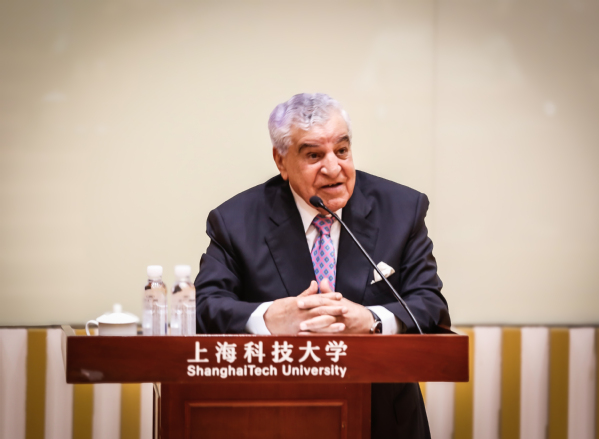
Zahi Hawass delivers a lecture at ShanghaiTech on September 20.
How were the pyramids built? Could there be undiscovered structures beneath the Great Sphinx? What caused the death of Tutankhamun? Zahi Hawass, a renowned Egyptian archaeologist and former secretary-general of Egypt’s Supreme Council of Antiquities, was invited to discuss these long-standing mysteries at the 33rd ShanghaiTech Lecture on September 20. Professor Fan Xin, vice dean of the Institute of Humanities, hosted the event.
Hawass is one of the most influential figures in contemporary Egyptian archaeology. He has led archaeological excavations at major sites including the Giza Plateau, Saqqara, the Bahariya Oasis, and the Valley of the Kings, making a series of significant discoveries. He was also among the early scholars to introduce modern technologies into Egyptian archaeology. By combining archaeological fieldwork with scientific methods, his team has brought new perspectives to the study of ancient Egyptian society and history.
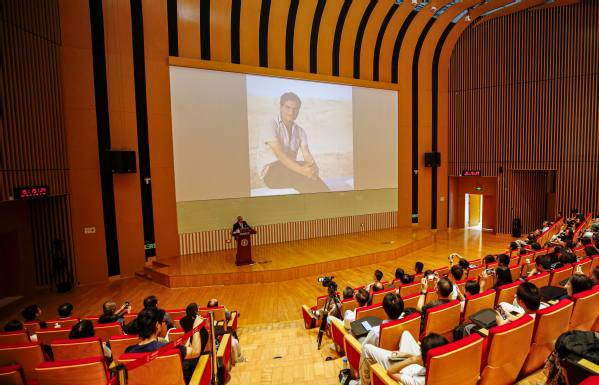 Zahi Hawass shares his stories of his archaeological discoveries in Egypt.
In his lecture titled “Secrets of the Pharaohs: New Discoveries in the Pyramids and the Valley of the Kings,” Hawass addressed these long-standing questions based on his own research, drawing on evidence from archaeological excavations as well as modern technologies such as CT scanning, DNA analysis, and ground-penetrating radar.
Hawass provided new insights into the lives of the people who built the pyramids, including their diet and daily life, while also shedding light on the familial relationships among members of the ancient Egyptian royal family.
He also introduced several recent projects, including ongoing excavations in the Valley of the Kings, the discovery of the “Lost Golden City” in Egypt, and interdisciplinary studies of mummies using advanced scientific techniques.
His lecture highlighted how modern technology is expanding the possibilities of archaeological research. From microscopic DNA evidence to the large-scale structures of archaeological sites, scientific tools are enabling researchers to examine ancient remains with greater precision and from new perspectives. The intersection of archaeology and modern science and technology is also an area of interdisciplinary research at ShanghaiTech’s Institute of Humanities.
During the Q&A session, Hawass shared reflections on his decades-long career in the field and encouraged young people to make the most of their time, sustain their passion, and turn their interests into meaningful pursuits. Looking ahead, he said that many historical mysteries remain to be explored and that he will continue his work in archaeological excavation and research.
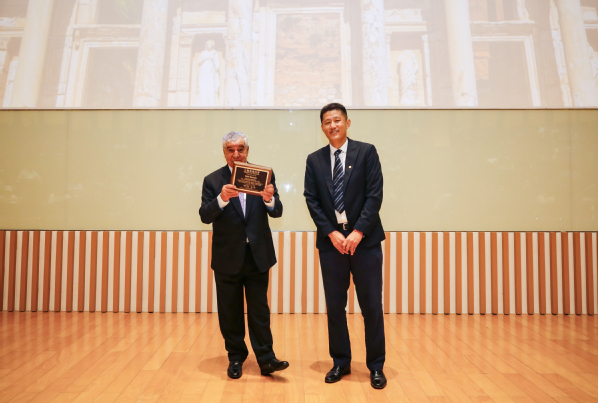 Zahi Hawass (left) smiles as he holds the commemorative plaque presented by Vice President Liu Zhi (right).
At the conclusion of the event, Vice President Liu Zhi presented Hawass with a commemorative certificate for the ShanghaiTech Lecture.