

The nervous system comprises two major divisions: the central nervous system (CNS) and the peripheral nervous system (PNS). Structures within the PNS, such as the dorsal root ganglia, arise from neural crest cells. Early neural crest induction occurs at the neural plate border, and neural crest formation is closely coordinated in space and time with neural tube development, particularly in the dorsal region. However, existing in vitro organoid models largely focus on generating central or peripheral neural lineages in isolation, making it difficult to fully recapitulate the dynamic processes of their coordinated development and interactions in vivo. This limitation constrains their utility in elucidating the mechanisms regulating neural development, modeling diseases associated with developmental abnormalities, and evaluating drug effects.
On September 18, the research team led by Associate Professor Xiang Yangfei at the School of Life Science and Technology, ShanghaiTech University, published a study in Developmental Cell entitled “Self-organizing human dual neural organoids model regional disease defects and teratogenicity.” Using human pluripotent stem cells, the team generated, for the first time, self-organizing organoids in which central and peripheral neural tissues co-develop, providing a new model platform for studying human neural development in vitro.
By modulating key developmental signals, including Wnt, FGF2, BMP, and retinoic acid, the research team successfully induced the co-differentiation of central and peripheral neural lineages. Through self-organization, these lineages formed two regions—a sensory ganglion-like (peripheral) region and a dorsal neural tube-like (central) region—that were morphologically distinguishable under bright-field microscopy. This study is the first to achieve coordinated development of peripheral and central neural tissues within a single human organoid, with the resulting tissues exhibiting cellular compositions and transcriptomic profiles consistent with those of their in vivo counterparts.
Building on this platform, the researchers leveraged the model’s ability to capture both central and peripheral neural fate specification to dissect how distinct signals regulate the induction of these two fates. Notably, Wnt signaling exhibited bidirectional regulatory effects: Wnt inhibition shifted cells entirely toward a central neural fate; low-dose Wnt activation drove organoids almost exclusively toward a peripheral neural fate; intermediate-dose activation enabled the co-differentiation of central and peripheral neural lineages; and high-dose activation again suppressed peripheral fate induction. These findings offer new insights into the fine-tuned regulation of central and peripheral neural fate specification in humans.
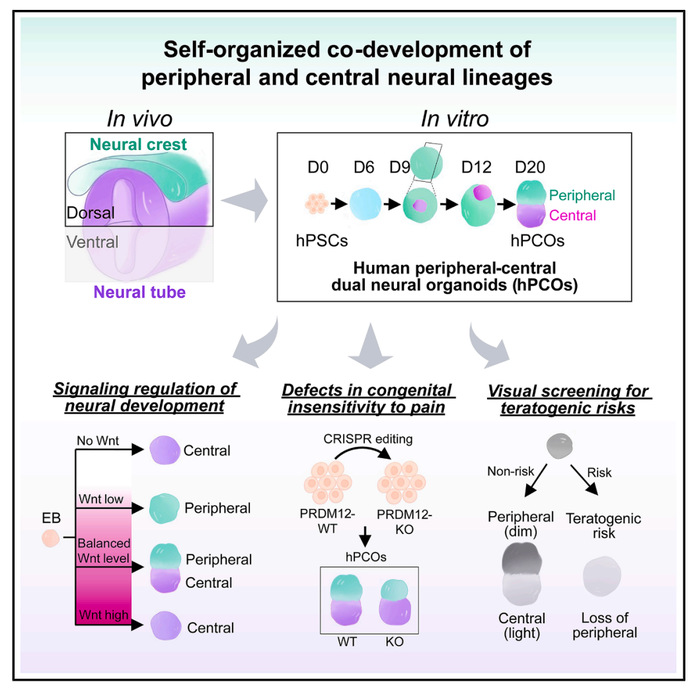 Graphical abstract of the study
The study also successfully established an organoid model of congenital insensitivity to pain (CIP). Knockout of the CIP-associated gene PRDM12 led to a marked reduction in the size of the peripheral region, fewer nociceptive neurons, and diminished calcium responses to capsaicin stimulation in mutant organoids. In contrast, development of the central region within the same organoid, which shared the same genetic background and culture conditions, remained largely unaffected. These results recapitulated key structural and functional features of CIP in vitro, highlighting the unique value of this organoid model for studying region-specific neurodevelopmental disorders.
For drug evaluation, the team leveraged the direct microscopic distinguishability of the organoids’ peripheral and central regions to develop a morphology-based approach for assessing teratogenic risk, making screening more straightforward and efficient. The results showed that both valproic acid and thalidomide blocked peripheral region development, consistent with their known teratogenic effects. Building on this approach, the team combined high-throughput screening with AI-based image recognition to systematically screen FDA-approved drugs. This work established a simple and efficient human organoid-based platform for assessing teratogenic risks to the development of the central and peripheral nervous system, providing an in vitro early-warning tool and experimental evidence to support medication safety assessment during pregnancy.
In summary, this study established the first organoid model that enables the coordinated development of human peripheral and central neural tissues in vitro. Through its applications in elucidating signaling mechanisms, disease modeling, and drug screening, the study demonstrated the model’s considerable potential for human neural development research and translational medicine.
Lu Xiaoxiang and Chu Siyuan, doctoral students at ShanghaiTech University, are co-first authors of the paper. Xiang Yangfei and Ma Shaojie of the Center for Excellence in Brain Science and Intelligence Technology, Chinese Academy of Sciences, are co-corresponding authors. ShanghaiTech University is the lead institution for this study.
*This article is provided by Prof. Xiang Yangfei