

The ShanghaiTech team earned three honors: first place in the Distributed Testing Event, second place in the Analytical Performance, and the SensUs Medal Certificate
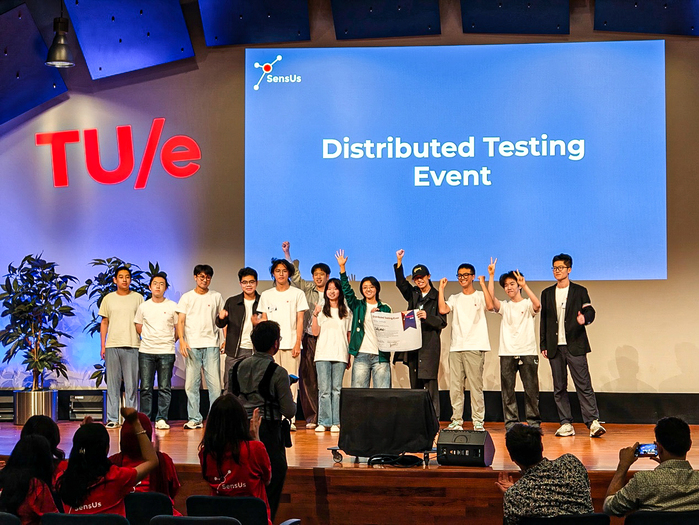
The MakeSense team celebrates its first-place finish in the Distributed Testing Event
Each year, SensUs focuses on a biomarker or therapeutic target with significant clinical relevance. This year’s competition centered on levodopa (L-DOPA), a standard medication for treating Parkinson’s disease. Because patients can differ significantly in how they absorb and metabolize the drug, fluctuations in drug concentrations can contribute to motor complications. Meanwhile, conventional clinical testing typically relies on laboratory-based equipment, making continuous, real-time monitoring difficult. Developing a wearable system for continuous monitoring could therefore support more individualized treatment.
To address this challenge, ShanghaiTech’s MakeSense team developed a wearable electrochemical monitoring system for measuring L-DOPA in interstitial fluid. The system integrates an enzyme-based electrochemical sensing interface, a flexible three-electrode microwire sensor, and a coin-sized readout device capable of measuring picoampere-level currents. It continuously acquires sensing data and wirelessly transmits the data.
The team also used artificial intelligence to design a de novo protein that can selectively recognize L-DOPA while minimizing interference from structurally similar compounds. Experiments showed that the system maintained stable and selective detection in the presence of potential interferents found in physiological environments, demonstrating the feasibility of continuous L-DOPA monitoring.
In the Distributed Testing Event before the final competition, the MakeSense system ranked first for detection accuracy. During the on-site final, the team further optimized its detection device and performed sample testing using an implantable microwire electrode with a diameter of just 0.4 millimeters. The team ultimately placed second in Analytical Performance. It also completed all of the competition’s required challenges and received the SensUs Medal Certificate.
“This experience has given us a clearer direction for our future research.”
The MakeSense team is a multidisciplinary, bringing together students from life sciences, information science, biomedical engineering, physical science, and industrial design. They collaborated across areas including protein design, electrochemical sensing, microwire fabrication, low-noise electronics, animal experiments, software development, and system integration. The team was supported by funding from the School of Life Science and Technology through its technology transfer proceeds.
The three honors recognize the team’s work in developing and validating the sensing system, while marking a new starting point for further research.
“From research in laboratory to an international competition, we have gained a deep understanding that turning a scientific idea into a reliable sensing system requires close collaboration across disciplines, as well as repeated experimentation to test and refine every aspect of the design,” said Chen Yangbin, team leader of MakeSense. “We will continue to improve the system and conduct rigorous validation, with the goal of moving the technology toward practical applications and ultimately making a tangible difference for patients.”