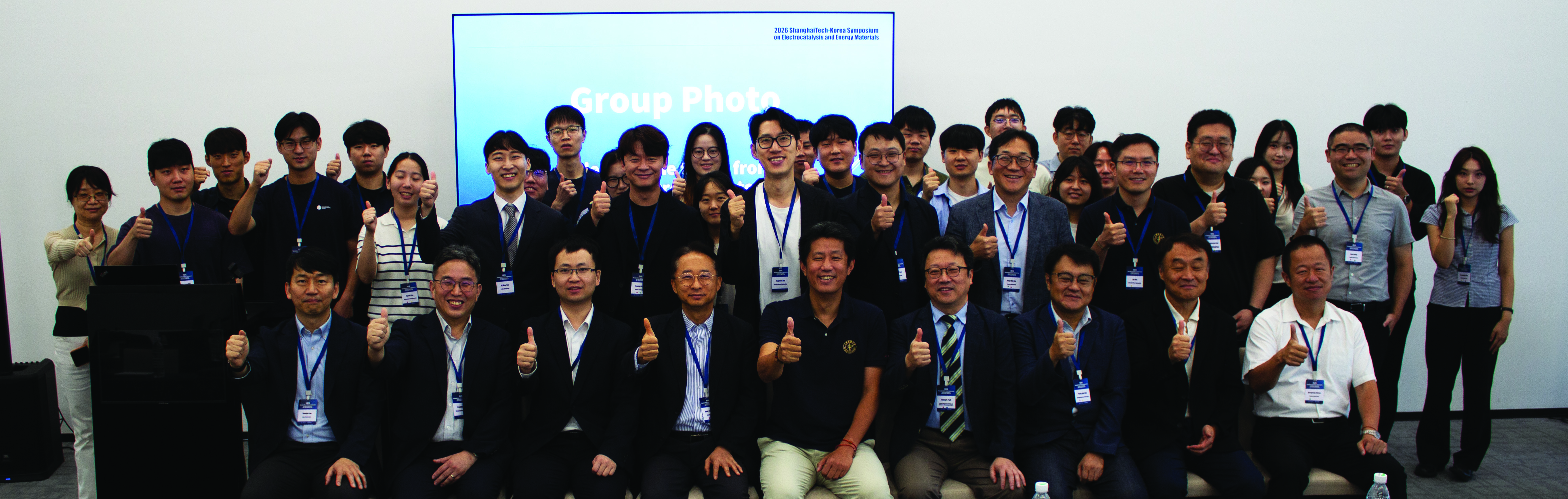
 Group photo
From September 11 to 12, the 2026 ShanghaiTech–Korea Symposium on Electrocatalysis and Energy Materials, held at the Shanghai Eastern Hub International Business Cooperation Zone, brought together researchers from leading universities and research institutions in China and South Korea to discuss recent advances in electrocatalysis, energy materials, and surface and interface science.
Co-organized by the School of Physical Science and Technology (SPST) and Accounts of Materials Research (AMR), a journal jointly published by ShanghaiTech and the American Chemical Society (ACS), the two-day symposium provided a forum for researchers working across closely related areas to share their latest findings and explore opportunities for future collaboration. In his opening remarks, Liu Zhi, vice president of ShanghaiTech and executive editor of AMR, emphasized the importance of international scientific collaboration and ShanghaiTech’s strong support for such efforts.
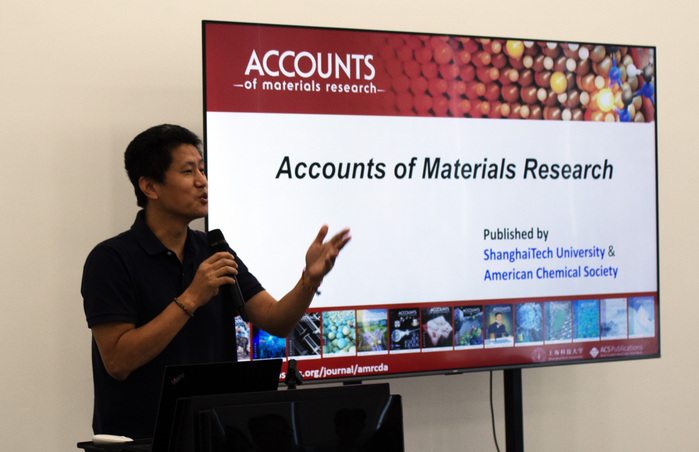
Opening remarks by Vice President Liu Zhi
The symposium maintained and expanded the academic exchange dated back to the first ShanghaiTech–Korea Symposium held in 2024. Associate Professor Franklin Kim at SPST, who led the organization of the symposium, noted that he was particularly pleased to see that contacts made at the previous symposium had developed into ongoing scientific interactions and joint research. He expressed the hope that the symposium would provide further opportunities for researchers to deepen these ties and initiate new projects.
The scientific program featured 21 invited presentations, with 11 speakers from South Korea and 10 from China. Presentations covered a broad range of topics spanning electrocatalysis, interfacial chemistry, battery materials and degradation, and data-driven approaches to energy research. The program reflected the interdisciplinary nature of the field, bringing together researchers who approach related challenges from different scientific perspectives. Speakers were from institutions including ShanghaiTech University, Fudan University, Tsinghua University, Shanghai Jiao Tong University, Seoul National University, Korea Advanced Institute of Science and Technology, Sungkyunkwan University, Inha University, Gwangju Institute of Science and Technology, Yonsei University, and Korea University.
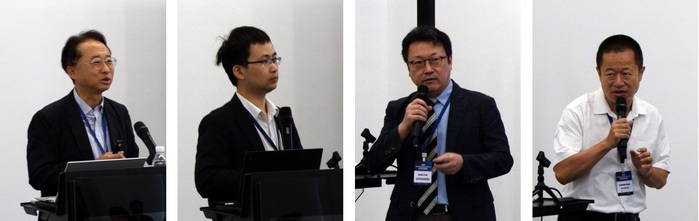
Invited presentations given by Prof. Sang-Young Lee (Yonsei), Prof. Chen Xiang (Tsinghua), Prof. Jeong Y. Park (KAIST), and Prof. Gengfeng Zheng (Fudan) (from left to right)
A poster session provided an additional forum for graduate students and early-career researchers to present their work and engage directly with faculty members and fellow students. A total of 26 posters were presented, and four poster awards were given in recognition of outstanding student contributions.
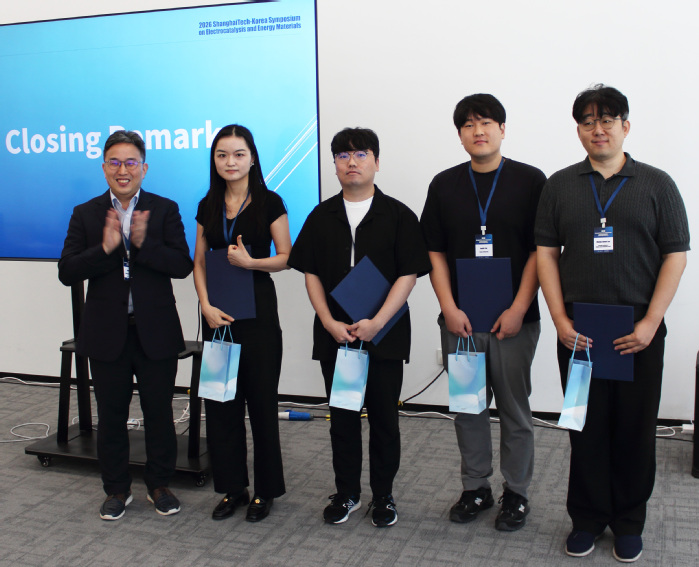
Prof. Franklin Kim (left) congratulates student poster award recipients
Beyond the formal program, participants continued their discussions during meals and other activities, providing opportunities to exchange ideas and discuss potential areas of mutual interest. The participation of graduate students alongside faculty members also brought students into the broader academic community represented at the symposium.
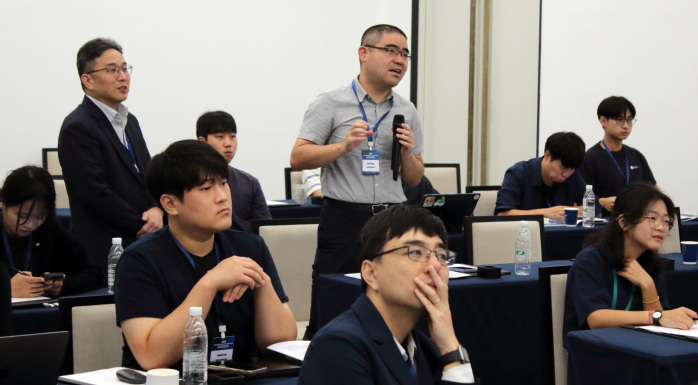
Discussions during scientific sessions
The 2026 symposium marks another step in building academic ties between researchers in China and South Korea working in energy-related fields. By bringing together researchers with complementary expertise and creating opportunities for continued interaction, the symposium seeks to provide a foundation for future scientific collaboration. It also contributes to the longer-term goal of establishing Shanghai as a hub for sustained scientific exchange between researchers in China and South Korea.