
On August 24, internationally renowned physicist and superconducting quantum computing pioneer Professor Jaw-Shen Tsai, a Fellow of the American Physical Society and the Academia Sinica, delivered the 32nd ShanghaiTech Lecture at ShanghaiTech University. Titled “Rise of Superconducting Quantum Circuits—A Personal Journey,” the lecture offered an insider’s view of how superconducting circuits developed over more than half a century. Professor Tsai also shared his personal experiences of some of the field’s landmark breakthroughs. The lecture was chaired by Xie Xiaoming, dean of the School of Physical Science and Technology.
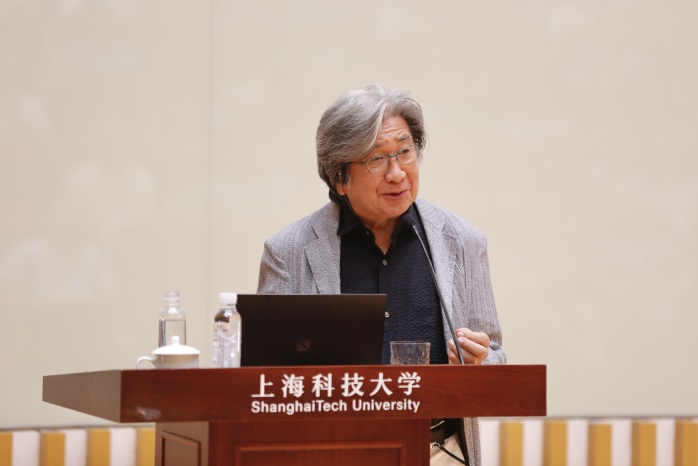
Jaw-Shen Tsai sharing his personal experiences.
Superconducting quantum circuits are one of the leading approaches to building quantum computers. By engineering circuits from superconducting materials and operating them at extremely low temperatures, scientists can create macroscopic quantum systems whose behavior can be precisely controlled.
Prof. Tsai traced the development of the field from the discovery of the Josephson effect, a critical phenomenon underlying superconducting quantum circuits, to the emergence of superconducting quantum computing. He also recalled his team’s early experiments using Josephson junctions, a key component of superconducting quantum circuits, to explore fundamental physics, including a precision test of gravitational redshift in 1987 and the observation of Shapiro steps, a distinctive quantum phenomenon, in high-temperature superconducting materials that same year.
A major turning point came as researchers learned to use superconducting circuits not only to study quantum phenomena, but also to create and control quantum states for information processing. In 1999, Prof. Tsai and his collaborators demonstrated the first solid-state qubit. A qubit, the basic unit of quantum information, can exploit quantum phenomena such as superposition to encode and process information in ways that differ fundamentally from conventional bits.
The work progressed from demonstrating a single controllable qubit to developing the basic operations needed for quantum computing. In 2003, Tsai’s team demonstrated the first solid-state controlled-NOT (CNOT) gate, an essential two-qubit operation that enables quantum bits to perform conditional logical operations on one another. In 2007, the team demonstrated switchable coupling between qubits, an important capability for implementing universal quantum gates. Together, these milestones marked important steps toward using superconducting circuits to perform increasingly sophisticated quantum computations.
Tsai also discussed more recent research, including work on bosonic qubits, and revisited his 2012 research on coherent quantum phase slips.
During the Q&A session, faculty and students raised questions about the scalability of quantum bits and the future development of superconducting quantum computing. Tsai engaged with the audience on these and other frontier topics.
The lecture offered more than a chronology of scientific breakthroughs. Through the perspective of a scientist who has been involved in the field for decades, it showed how questions in fundamental physics can gradually lead to new ways of controlling quantum systems and processing information. It also offered students and faculty an opportunity to gain a broader perspective on the scientific ideas and technological advances that have shaped superconducting quantum computing.
Following the lecture, President Feng Donglai presented Jaw-Shen Tsai with a commemorative certificate for his participation in the ShanghaiTech Lecture and thanked him for sharing his insights with the university community.
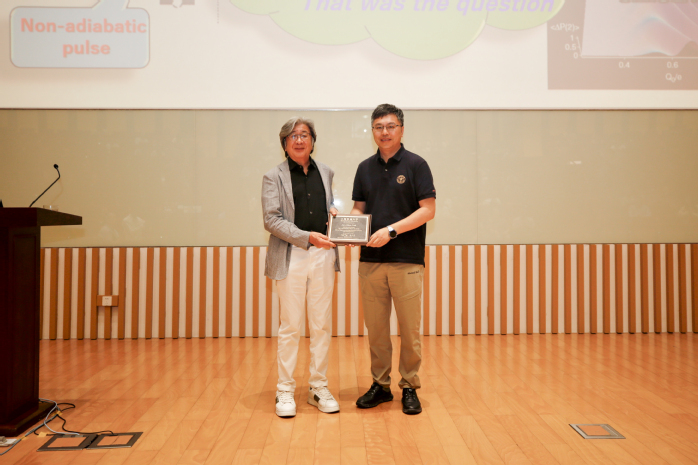
Feng Donglai (right) presenting Jaw-Shen Tsai (left) with a certificate.