—The achievement marks the first time a research team from China has received the honor
In July, a research team led by Assistant Professor Wang Chundong from the School of Information Science and Technology (SIST) at ShanghaiTech University has won the Best Paper Award at the 35th ACM International Symposium on High-Performance Parallel and Distributed Computing (HPDC 2026).
The award-winning paper, titled “Pome: Parallelizing I/Os and Computations for Efficient LSM-tree-based Data Storage,” was selected from 281 submissions presented at the conference. The paper proposes a new approach to improving the efficiency of storage systems based on Log-Structured Merge trees (LSM trees). Prof. Wang served as the corresponding author.
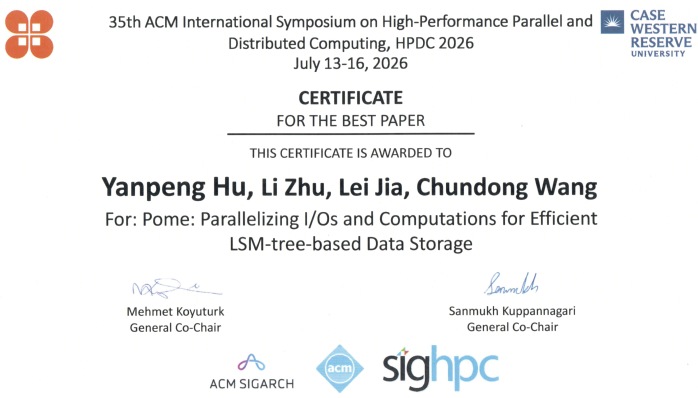
The paper’s authors, Hu Yanpeng, Zhu Li, and Jia Lei, are graduate students in Wang’s research group. All three completed their undergraduate studies in Computer Science and Technology at ShanghaiTech before continuing their graduate studies at the university. Hu Yanpeng attended the conference in person and presented the research findings.
LSM trees are widely used in modern data storage systems. They have been adopted by companies such as Google and Meta for managing large-scale data storage and are also widely used in applications including blockchain.
To maintain efficient performance, LSM-tree-based systems periodically reorganize and merge stored data through a process known as compaction. However, in traditional approaches, data processing and storage operations often need to be performed sequentially. After data are reorganized, the system must wait for subsequent input/output (I/O) operations to complete, creating bottlenecks that limit overall performance.
To address this challenge, the research team developed Pome, a new approach that enables computation and I/O operations to run in parallel. By redesigning the workflow of data processing and storage, Pome separates computation from storage operations, reducing unnecessary waiting time and improving the efficiency of LSM-tree-based storage systems.
The approach also incorporates asynchronous I/O technologies to accelerate data processing and introduces an adaptive mechanism to prevent storage congestion caused by increased data-writing speed. Experimental results show that Pome significantly reduces processing time along the critical path and outperforms several existing optimization approaches for LSM-tree systems.
The achievement highlights ShanghaiTech’s research strength in computer systems and high-performance computing, as well as its distinctive approach to integrating undergraduate education with research training.