When Gu Qian MS ’22, PhD ’26 left her laboratory, she had little idea that a year later her days would be spent not with pipettes and cell cultures, but with industrial parks, construction sites, and local businesses.
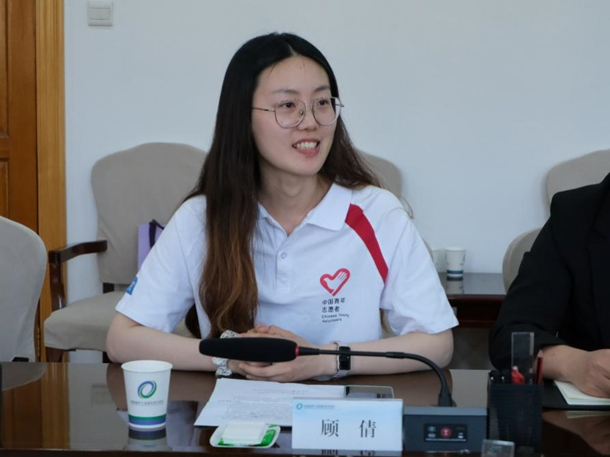
A joint-trained PhD student at the School of Life Science and Technology and the Shanghai Institute for Advanced Immunochemical Studies of ShanghaiTech, Gu had grown accustomed to answering questions through experiments. In 2025, however, she chose to step away from the bench and join a national volunteer initiative, the Go West program, spending a year as a volunteer to serve a local community in Yining Border Economic Cooperation Zone in Xinjiang.
The experience took her far beyond her academic discipline. It also reshaped the way she thinks about service, research, and personal growth.
A window onto her journey to serve in Xinjiang
Long before Xinjiang, volunteering had already become an important part of Gu’s university life.
“I have volunteered in science outreach, orientation programs, blood donation events, and major public events such as the World Artificial Intelligence Conference and the Shanghai Marathon,” Gu reflected. “What stayed with me was never simply the events themselves, but the feeling of working alongside others toward a shared purpose.”
“When a group of people is working towards a goal, I can always feel a kind of power.” Gu smiled.
One experience, in particular, left a lasting impression. During a campus outreach event for local families, she guided them to visit university laboratories. At the end of the visit, several parents thanked her, “We have learned more than we expected through today’s visit!” It was a simple afternoon, but it made her realize that even a small act of service could have a meaningful impact on someone else.
That understanding deepened in the summer of 2023, when she joined ShanghaiTech’s Field Immersion Program as a team assistant in the Liangshan region of Sichuan Province to conduct field research on the educational development of the Yi ethnic group.
Among everything she saw, one image has stayed with her ever since—a Yi teenage girl, excited beyond words as she prepared to begin high school.
“At that moment,” Gu recalled, “I realized that education doesn’t just change what someone knows. It changes what they believe is possible.”
The trip opened a window onto a China she had never truly known, and planted a quiet thought in her mind: if the opportunity came, she wanted to see more of the country beyond the campus.
Bringing a researcher’s mindset to public service
That opportunity arrived two years later.
Assigned to the Investment Promotion Service Center of Yining Border Economic Cooperation Zone, Gu suddenly found herself surrounded by unfamiliar concepts—from industrial planning to business development and investment projects.
For someone trained in biology, it was an entirely new language.
There were moments of uncertainty, but she soon realized that years of research had prepared her in ways she had never expected.
“No experiment is ever wasted, and neither is any effort at work.”
Instead of feeling overwhelmed by what she didn’t know, she approached each new challenge the way she would approach a research project: learn the background, ask questions, gather information, and solve problems one step at a time.
She gradually discovered that research had taught her more than scientific knowledge. It had taught her how to face uncertainty with curiosity, persistence, and the confidence that solutions can be found through careful observation and steady effort.
Discovering the quiet meaning of public service
What changed Gu most, however, was not learning a new job.
It was learning what public service truly means.
She came to realize that meaningful work is rarely defined by dramatic moments. More often, it grows out of patient communication, careful coordination, and the willingness to solve one small problem after another.
During her year in Xinjiang, one strong statement made by a local officer stayed with her. “As long as I can help local farmers sell their products, anything I do is worthwhile.”
The words were simple, yet they reshaped the way she thought about service.
She began to see that the value of public service is not measured by how visible the work is, but by whether it makes people’s lives a little easier. Progress often comes quietly, through countless ordinary tasks that few people ever notice.
Standing at the border a year later, watching a China-Europe freight train depart from Yining, she found herself seeing familiar news headlines differently.
What had once seemed like distant national initiatives had become something tangible—projects taking shape, businesses growing, and communities changing before her eyes.
She had spent years observing the microscopic world through a microscope. Now she was witnessing another kind of transformation, unfolding across an entire region.
Both, she realized, were driven by the same purpose—making tomorrow a little better than today.
Moving forward with a broader perspective
Gu later shared her experiences with fellow students and encouraged others to consider public service.
Some people asked whether taking a year away from research had been worth it. Her answer never changed.
“Spending your time to serve in the west, like pursuing a PhD, is one of the momentous choices of one’s life. It is a new challenge and a way of adding depth to life.”
After completing her service, Gu returned to ShanghaiTech to finish her doctoral studies. She brought back not only new experiences, but also a broader perspective on what it means to contribute.
Wherever her next step leads, she knows she will carry both lessons with her: the habits of a researcher, and the heart of a volunteer.
As she has come to believe, spring is not a season that simply arrives. It blossoms in every step taken toward something larger than oneself.