

Recently, the research group led by Professor Chen Jia at the School of Life Science and Technology (SLST), ShanghaiTech University, together with collaborators, made important advances in the in vivo delivery of cytosine base editors using virus-like particles. The findings were published in Nature Biotechnology under the title “Efficient in vivo cytosine base editing via virus-like particles with uracil DNA glycosylase inhibition.” By engineering both the base editor and virus-like particle (VLP) packaging strategies, the research team developed an efficient in vivo cytosine base editing system, tBE-VLP4. By delivering the transformer base editor (tBE) via VLPs, the system enabled efficient C-to-T editing in mice.
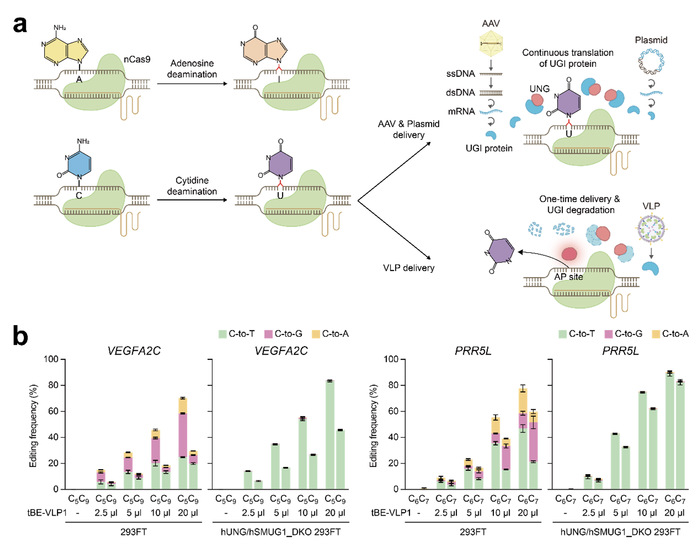
Figure 1: a. Schematic illustration of ABE- and CBE-mediated deamination of adenosine and cytidine in cells. b. Editing efficiency of tBE-VLP1 in wild-type 293FT cells and hUNG/hSMUG1 double-knockout cells.
VLPs are a promising gene-editing delivery tool. They can transiently deliver editors into cells in the form of ribonucleoprotein complexes or mRNA. Compared with AAV or plasmid delivery, VLPs can reduce off-target editing and potential safety risks associated with prolonged editor expression. Previously, VLPs have been used to deliver Cas9-sgRNA, adenine base editors (ABEs), and prime editors (PEs), but their efficiency in mediating cytosine base editing (CBE) in vivo has remained limited. CBE converts cytosine into uracil through deamination, ultimately enabling C-to-T conversion. However, endogenous cellular uracil DNA glycosylase (UNG) recognizes and excises uracil in DNA, reducing editing efficiency and increasing byproducts. Conventional AAV or plasmid delivery can continuously express UGI protein to inhibit UNG, whereas VLPs provide only a one-time, limited amount of UGI protein. The research team found that insufficient UNG inhibition limits the in vivo editing efficiency of VLP-delivered CBE.
The research team first tested VLP-delivered tBE in wild-type 293FT cells and hUNG/hSMUG1 double-knockout 293FT cells. The results showed that, compared with wild-type cells, C-to-T editing efficiency was significantly increased in hUNG/hSMUG1 double-knockout cells, while C-to-A and C-to-G byproducts were markedly reduced. This finding indicates that endogenous uracil DNA glycosylase activity is an important factor limiting the editing efficiency of VLP-CBE.
To address the core issue of insufficient UNG inhibition, the research team further carried out systematic optimization of the tBE system and VLP packaging strategy. They introduced additional RNA aptamers into tBE to enhance UGI recruitment and constructed multiple improved VLP systems.
Among them, the optimized tBE-VLP4 significantly increased the loading levels of UGI and sgRNA in VLPs and demonstrated stable and efficient cytosine base editing in 293FT, HeLa, U2OS, and monkey-derived FRhK-4 cells. Further results showed that tBE-VLP4 is also compatible with the Cas9 SpG variant and conventional CBE architecture, suggesting that the system has strong versatility and scalability.
In mouse experiments, tBE-VLP4 demonstrated favorable editing efficiency and disease-intervention effects. After a single tail-vein injection, tBE-VLP4 achieved an average C-to-T editing efficiency of 46.0% at the mPcsk9 locus in mouse liver, significantly reducing serum PCSK9 protein and total cholesterol levels. In a mouse model of hereditary tyrosinemia type I, the research team used tBE-VLP4 to target the mHpd locus, achieving a maximum editing efficiency of 64.2%. The treatment successfully reduced weight loss and lethality in the mice and markedly alleviated liver function impairment. In addition, the research team delivered tBE-VLP4 to retinal pigment epithelial cells via subretinal injection to edit the mVegfa locus, achieving an average editing efficiency of 24.2%. In a laser-induced choroidal neovascularization model, this strategy significantly alleviated lesion severity and protected retinal function, suggesting that tBE-VLP4 is not only applicable to liver editing but also has potential for expansion into ophthalmic disease therapy.
In terms of safety, the research team detected no obvious DNA or RNA off-target editing induced by tBE-VLP4 in either in vitro or in vivo experiments. Compared with AAV or LNP-mRNA delivery methods, tBE-VLP4 showed better editing specificity.
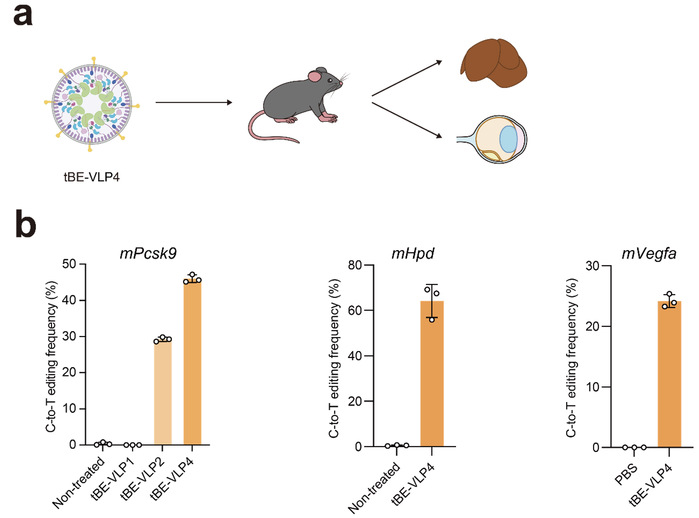
Figure 2: a. Schematic illustration of tBE-VLP4 infection of mouse liver and retinal pigment epithelial cells. b. Editing efficiencies of tBE-VLP system at different loci in mice.
This study elucidates the key mechanism limiting the in vivo efficiency of VLP-delivered CBE and, based on this finding, establishes tBE-VLP4 as an efficient and precise in vivo cytosine base editing platform, offering a new strategy for safe and efficient in vivo gene-editing therapies.
Zhu Junjie, a fourth-year PhD candidate, Ding Lin, a second-year PhD candidate, and Li Jifang, a 2025 PhD graduate, all from SLST, together with Liu Kaiming from the Institute of Biomedical Sciences, Fudan University, and Zhu Xingyu from the Eye & ENT Hospital of Fudan University, are co-first authors. Professor Chen Jia at Gene Editing Center of the SLST; Professor Yang Li at Institute of Biomedical Sciences, Fudan University, and the Children’s Hospital of Fudan University; and Professor Hong Jiaxu of the Eye & ENT Hospital of Fudan University are the corresponding authors of the paper.
*This article is provided by Prof. Chen Jia