

As a child, Liu Chenfei ’26 was fascinated by theme parks, digital exhibitions, and video games. What captivated her was not simply dazzling visuals or cutting-edge technology, but the emotions they inspired—the wonder, curiosity, delight, and even the brief sense of escape they offered.
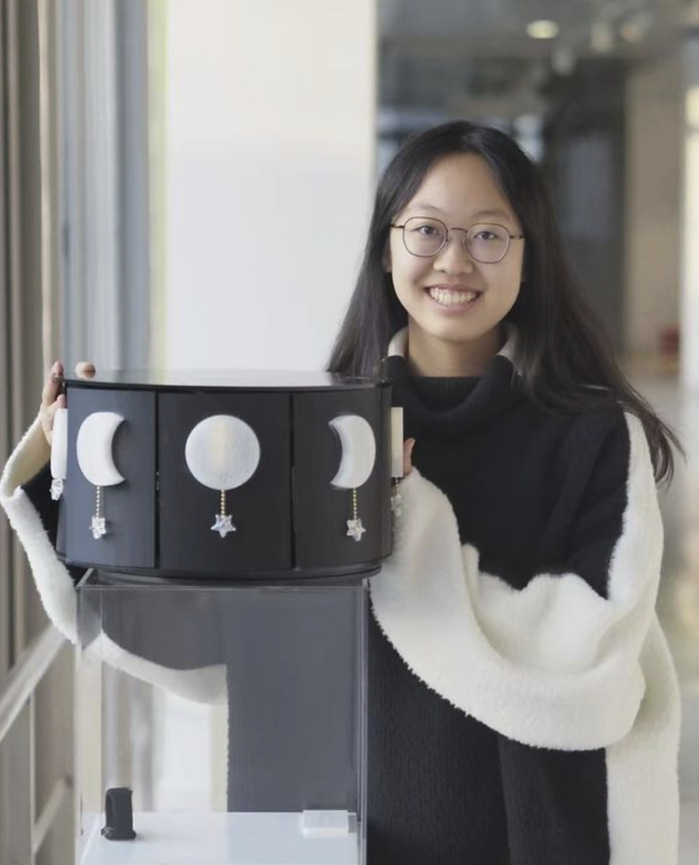
She often wondered: What would it be like to create experiences like these for others?
Driven by that curiosity, Liu enrolled in the School of Creativity and Art (SCA) at ShanghaiTech University, where she chose to study Entertainment Design.
At ShanghaiTech, she immersed herself in every creative expression she could explore. From filmmaking and game design to interactive art, from classroom projects and international competitions to industry internships, she continually placed herself in new environments and experimented with new forms of expression. She was never simply trying to build a stronger portfolio. Instead, each project became part of her search for the answer to a question that had stayed with her from the beginning: What makes an experience truly meaningful?
The answer began to take shape during an industry internship in the summer after her sophomore year.
At a medical robotics company, she watched surgeons training with robotic surgical systems controlled by game controllers. A familiar gaming interface had been transformed into a medical training tool, making complex procedures more intuitive and accessible.
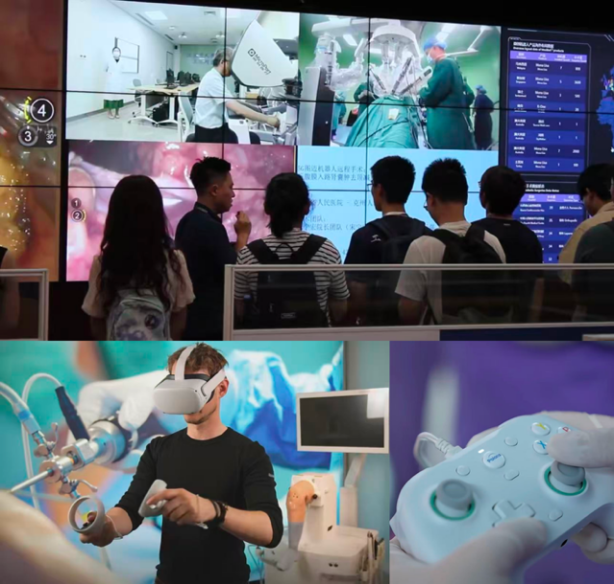
During an industry internship in AI and robotics, Liu observed how game-inspired technologies were being applied to robotic surgery, an experience that reshaped her understanding of entertainment design.
“In that moment, I realized that entertainment could be far more than entertainment,” said Liu. “It could help people to learn, sense, and understand the world, and, at times, even give them the courage to confront difficult challenges.”
From then on, she began to explore entertainment beyond its traditional boundaries.
She came to believe that in healthcare, education, and public engagement, what people truly need is not more entertainment, but more engaging ways to learn, participate, and overcome challenges. Entertainment, she realized, could become exactly that kind of bridge.
Guided by this idea, she created a series of projects with real-world impact. She produced a digital artwork for her grandmother living with Alzheimer’s disease, hoping to preserve memories that were gradually fading away. She designed an interactive game to help adolescents with anorexia nervosa develop healthier eating habits, using play to ease the psychological burden of recovery. Working with the Shanghai Astronomy Museum, she also transformed abstract astronomical concepts into interactive experiences that visitors could directly engage with.
Although these projects addressed different topics, they were all driven by the same purpose: using entertainment technology to respond to real human needs, creating experiences that foster understanding, connection, and empathy rather than immersion alone.
At the same time, Liu also began questioning the other side of entertainment technology. She often asked herself, “As digital experiences become increasingly immersive and lifelike, could technology also begin to shape people in return—or even limit their ability to make their own choices?”
This question inspired her mixed-reality interactive film “The Last Play,” which explores the relationship between entertainment technology and humanity, as well as the ethical questions raised by an increasingly immersive digital future. The work was later exhibited at the Ars Electronica Festival in Austria.
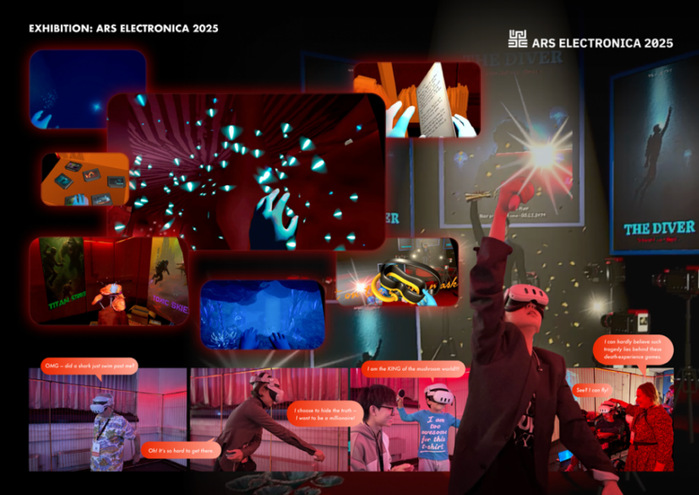
The mixed reality interactive film “The Last Play” explores the relationship between entertainment technology and humanity. It was selected for the 2025 Ars Electronica Festival.
If her earlier projects explored what entertainment could contribute to society, her semester as a short-term student at the University of California, Berkeley prompted her to ask a different question: How do experiences transform the people who live through them?
“Something more influential than the classroom was life itself,” she recalled.
Living in an unfamiliar environment, with an unfamiliar language and culture, required her to constantly adapt. Gradually, she realized that cross-cultural experiences are not simply about entering another country—they are about discovering a new understanding of oneself.
After returning to Shanghai, she transformed these reflections into her graduation project, “Tidal Diaspora.”
Using the metaphor of tides, the work combines real-time motion capture, spatial projection, interactive media, and dance performance to portray an individual’s journey through migration, change, and unfamiliar environments. The ebb and flow of the tides become a metaphor not only for movement, but also for repeatedly adjusting one’s course, reinterpreting the world, and rediscovering oneself.
The project ultimately reshaped her understanding of what an “experience” truly means.
As a child, she believed experiences existed to bring joy. Later, she hoped to create experiences that could help others. Today, she sees that every unfamiliar place, every new culture, every emerging technology, and every encounter with different people quietly leaves its mark on those who experience them.
What matters is not how many experiences one accumulates, but who one becomes because of them.
After graduation, Liu will pursue a master’s degree in Entertainment Technology at Carnegie Mellon University, USA.
Four years ago, she chose entertainment design because she loved extraordinary experiences. Four years later, she has come to believe that entertainment is never an escape from reality. Instead, it is a language that connects technology, humanity, and society—a language that helps people understand, empathize, and navigate an ever-changing world.
Perhaps years from now, another child will step into a world filled with wonder, curiosity, and imagination, just as she once did.
Only this time, the experience will have been created by Liu Chenfei.