

A tape-out test (the final stage of the design process for IC) shortly before the Spring Festival had left almost no one in the lab feeling optimistic.
After several rounds of fabrication attempts ended in failure, the team was left with just one device that successfully made it through fabrication. It was carefully placed on the testing platform, and as the measurement curve slowly appeared on the screen, the entire laboratory fell silent—the bandwidth had exceeded 100 GHz!
“Everyone was stunned,” Li Linze ’20, PhD ’26 recalled. “That device was almost our last hope.”
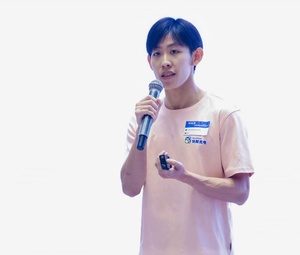
That single device later became the starting point for a series of optimizations. The team ultimately achieved record-setting performance in their ultra-high-speed photodetector chips, bringing them to an internationally leading level. Their work was published in Nature Photonics.
For Li, however, the greatest significance of the achievement was not simply publishing in a top journal. It reinforced his belief that even in a field widely regarded as mature and nearly exhausted, the most important questions are still worth pursuing.
Digging deeper where others saw no more room for discovery
Li’s journey into high-speed photonic chips began during his freshman year.
At a residential college luncheon, he had his first in-depth conversation with Professor Chen Baile from the School of Information Science and Technology. At the time, Li had no clear vision for his future, but he was deeply drawn to Chen’s thoughtful and pragmatic introduction to semiconductor photonic chips.
“Prof. Chen told me that it was a field with a long learning curve. You might spend years without seeing major results, but it lies at the heart of optical communications and is truly worth a long-term commitment.”
High-speed photodetector chips rely on a complex engineering process involving device design, fabrication, testing, and packaging. While it may not receive the same level of attention as many emerging research areas, it remains one of the key technologies underpinning high-speed optical communication systems.
As a junior undergraduate, Li joined Chen’s research group and began learning the complex processes involved in chip fabrication. Through hands-on research, he gradually realized that this was not only an exciting scientific challenge but also a technology with tremendous industrial potential.
Upon graduating with his bachelor’s degree, he chose to remain at ShanghaiTech to pursue a PhD.
“I knew it would be a difficult path,” he said. “But the more I learned about it, the more convinced I became that it was worth doing.”
Pushing performance beyond the established limit
During his doctoral studies, Li focused on ultra-high-speed photodetectors (UTC-PDs), a research area with decades of history. Many of the world’s leading laboratories had already pushed key performance metrics close to their limits, leading many researchers to believe that there was little room left for major breakthroughs.
To further improve device performance, the team had to continually shrink the device dimensions. But the increasingly demanding fabrication process caused repeated tape-out attempts to fail at the final stage.
“The hardest part wasn’t failing at the beginning,” Li said. “It was watching every previous step succeed, only to have everything fall apart at the very end.”
The turning point came during a test that no one expected to succeed. The team’s only device that successfully made it through the fabrication process achieved a bandwidth exceeding 100 GHz, opening the door to further improvements and setting a new performance benchmark for the field.

Concept image of Li’s ultra-high-speed photodetectors.
Looking back, Li believes the experience taught him that research demands patience and persistence.
“Very often, you don’t know whether the next experiment will succeed. But someone has to keep going.”
When research meets real-world demand
Following the publication of the paper, Li presented the team’s work at major international conferences.
At events such as the Optical Fiber Communication Conference and Exhibition (OFC), he not only met pioneers of the technology but also gained a much clearer understanding of industry demand.
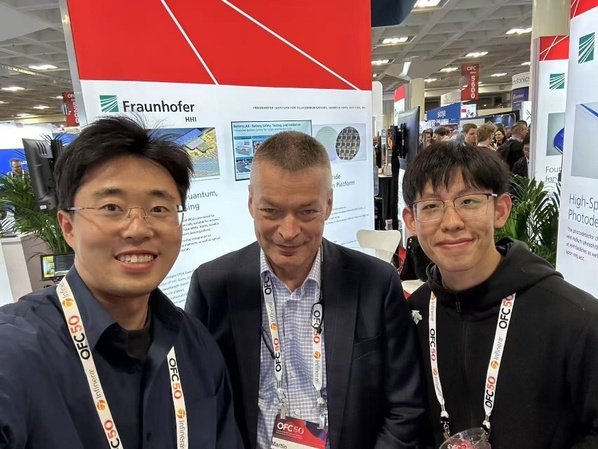
Li Linze (right) in the OFC conference.
Research groups working on photonic terahertz technologies and high-speed optical communications were actively seeking higher-performance photodetector chips.
“I realized that this wasn’t just an academic question—it was also a real industrial need.”
The technology had been validated, and the market had provided its answer.
Li and his teammates soon agreed to move beyond the laboratory and pursue commercialization. Together they founded Shanghai FastPhide Photonics Co., Ltd., dedicated to bringing high-speed photodetector chips to market. The startup later secured seed funding.
From pursuing the extreme to pursuing reliability
After becoming an entrepreneur, Li quickly realized that there was still a long road between scientific discovery and a successful product.
“Developing a product is completely different from doing research.”
In the laboratory, researchers strive to push performance to its limits. Customers, however, care far more about long-term reliability, consistent performance, and scalable manufacturing.
Becoming an entrepreneur did not change Li’s determination to tackle important problems, but it fundamentally changed the way he thinks about innovation. Instead of focusing solely on achieving the next record-breaking performance, he now concentrates on whether a product can be manufactured consistently, delivered reliably, and create lasting value.
“Customers don’t need a device that only sets records,” Li said. “They need a product they can truly rely on.”
The transition has also made him more grounded and pragmatic. Where he once focused primarily on pushing technical boundaries, he now asks how technology can better serve industry and generate real-world impact.
Looking back on his ten-year studies at ShanghaiTech, Li still remembers the words Prof. Chen shared with him when they first met: this was a path that demanded long-term commitment, one that might take years before producing meaningful results.
His experience has shown that a field does not lose its potential for innovation simply because it has been studied for decades.
From undergraduate student to doctoral researcher and now entrepreneur, Li’s role has changed. What has remained unchanged is his determination to keep moving forward where others believe the limits have already been reached.