
In an ultrasound examination room, physicians move quickly between scanning, interpreting images, and making diagnostic decisions.
For experienced specialists, many diagnostic clues have become second nature through years of clinical practice. For younger physicians, however, the same images often require more time and careful analysis.
Standing quietly in the corner of the room and observing the process, Zhou Zicheng ’26 found himself repeatedly thinking about one question: Could artificial intelligence help transform expert knowledge into tools that are accessible, scalable, and ultimately beneficial to more patients?
“AI should not be helping numbers on a published research paper—it should be helping doctors and patients in the clinic,” Zhou said.
When he first stepped into an ultrasound clinic, he had no idea that this belief would become the starting point of his future journey in biomedical engineering research.
Understanding biomedical engineering through real-world experience
After entering the School of Biomedical Engineering at ShanghaiTech University, Zhou was introduced to subjects such as AI and medical image processing for the first time.
Like many students fascinated by technology, he was initially drawn to algorithms, models, and performance metrics. As his studies progressed, however, he began to realize that the most compelling aspect of biomedical engineering was not the technology itself, but its connection to human health and patient care.
“At first, I was mostly interested in the technology itself. Over time, however, I realized that technology is ultimately about solving real-world problems. What makes biomedical engineering so unique is its ability to connect engineering innovation with clinical needs,” Zhou said.
He started to step beyond the classroom.
Through hospital visits and clinical observations, he saw firsthand how physicians make diagnostic decisions. Through interactions with industry partners, he learned how difficult it can be to translate a promising laboratory technology into a practical clinical solution.
“I used to think that once a technology was developed, the problem was solved,” Zhou recalled. “Later, I realized that there is still a long journey from the laboratory to the clinic.”
This understanding was further reinforced through hands-on innovation projects.
As team leader in the Ninth National Biomedical Engineering Innovation and Design Competition, Zhou and his teammates developed an MRI-compatible contactless cardiopulmonary monitoring system based on radar technology. Designed to address practical challenges in monitoring vital signs during MRI examinations, the project won First Prize among more than 2,000 teams nationwide.
The experience taught him that meaningful innovation is not simply about proposing a technical solution—it is about solving real-world problems.
As he became increasingly exposed to clinical settings, Zhou also began to identify the field that most inspired him—medical AI.
From identifying problems to solving them
A project presentation in a Medical Image Processing course first sparked Zhou’s interest in medical AI research. He later joined the research group of Assistant Professor Qian Xuejun and began working on ultrasound image analysis.
Frequent interactions with clinicians offered him a deeper understanding of ultrasound-based diagnosis.
Ultrasound is widely used because it is real-time, convenient, and cost-effective. Yet disease screening and risk assessment often rely heavily on physicians’ experience. Meanwhile, high-quality medical resources are concentrated in major hospitals, leaving many primary healthcare institutions with limited access to specialized expertise.
These observations led Zhou to ask another important question: How could AI help improve diagnostic efficiency and accuracy while making expert knowledge more widely available?
“If we can transform expert experience into something that can be shared and replicated, then more young physicians can benefit from it—and ultimately so can more patients,” he said.
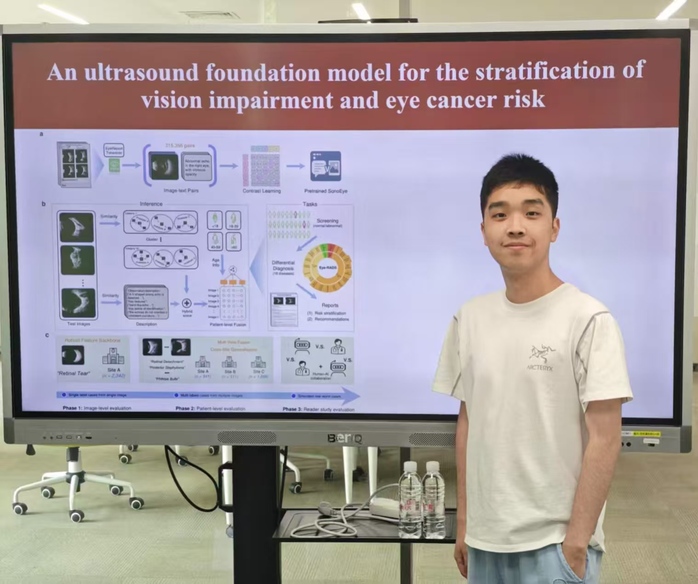
Motivated by this vision, Zhou participated in the development of SonoEye, a vision-language foundation model for ophthalmic ultrasound. The model is designed to understand both ultrasound images and clinical reports, providing support for disease screening, vision impairment warning, and ocular tumor risk assessment.
Throughout the project, Zhou and his collaborators moved continuously between the laboratory and the clinic, refining their research based on clinical feedback and improving the model through repeated rounds of development and validation.
Their efforts ultimately resulted in a publication in npj Digital Medicine, a Nature Portfolio journal, with Zhou serving as first author.
Yet what excited him most was not the publication itself.
In physician-reading studies, AI assistance significantly improved the diagnostic performance of young physicians and non-specialists. Seeing the technology help doctors make better clinical decisions was a defining moment.
“For the first time, I felt that research was not something distant from clinical practice,” Zhou said. “It could genuinely help solve real problems.”
Moving forward with a clear purpose
Much of Zhou’s undergraduate life was spent moving between classrooms, laboratories, and hospitals.
From acquiring knowledge to identifying meaningful questions, and from participating in projects to conducting independent research, he gradually transformed from a student into a researcher.
Looking back, Zhou believes his greatest achievement was not a particular award, publication, or academic milestone. Rather, it was discovering the problem he wants to devote himself to solving—and finding a field he is passionate about pursuing for the long term.
This year, he will continue his journey at ShanghaiTech University as a doctoral student, focusing on medical AI research.
Looking ahead, Zhou plans to remain committed to ultrasound AI, building bridges between technological innovation and clinical needs so that more research advances can move beyond the laboratory and into real-world healthcare settings.
“I hope the work I do in the future will not only lead to publications,” he said. “I hope it will make its way into clinical practice and help solve real problems.”