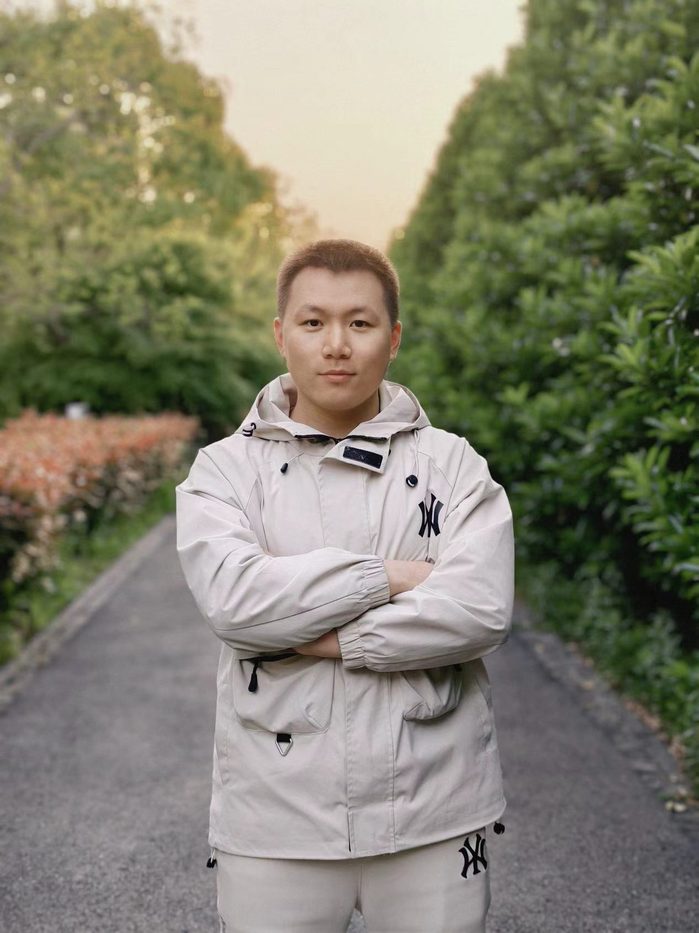
“Choosing ShanghaiTech and the iHuman Institute was the most important turning point in my life,” Hu Xiaolong PhD ’26 from the School of Life Science and Technology (SLST) reflected. Looking back on his doctoral journey, he thinks the most valuable harvest from five years of doctoral training was not a particular experiment, publication, or degree. It was learning how to change himself.
He believes that scientific research shaped not only his academic skills, but also his character, mindset, and approach to challenges.
Learning to act instead of delay
When Hu first began his PhD studies, he struggled with habits that many graduate students may find familiar. He tended to procrastinate, avoided difficult conversations, and often waited until deadlines were approaching before getting started. Everything changed after a painful lesson early in his doctoral training.
A batch of critical experimental samples was prepared too late, causing an entire experiment to fail. The experience forced him to confront a reality that scientific research is fundamentally different from studying for an exam. In research, lost time cannot always be recovered through last-minute effort.
After that setback, Hu adopted a simple rule for himself:“Start early. No matter what the outcome might be, get moving first.”
Gradually, action replaced procrastination. As he became more proactive, the anxiety that had accompanied him for years began to fade. For Hu, self-discipline eventually came to mean something different from self-punishment. Rather than forcing himself through pressure and guilt, he learned to guide himself toward action and consistency.
He summarizes his method to overcome hesitation as, “Once you have enough preparation, start first and think along the way. Sometimes you simply have to push yourself forward.”
Building resilience through research
Changing a habit was only the beginning. The greater challenge was maintaining that mindset through years of uncertainty and setbacks.
Throughout his doctoral study in life science, Hu encountered numerous obstacles, from protein complex purification and structural analysis to the intense pressure of manuscript revision and competition within the field. Many problems had no immediate solutions and required patience, persistence, and repeated attempts. Over time, he learned to focus less on immediate results and more on solving the next problem in front of him.
The difficulties themselves never disappeared. What changed was the way he responded to them.
Instead of waiting for the perfect moment, he learned to take the next step. Instead of dwelling on uncertainty, he concentrated on the work that could be done that day.
That steady accumulation of small efforts gradually transformed not only his research skills but also his temperament. By the time one of his major papers was accepted, the sense of accomplishment came not primarily from the publication itself. What mattered more was realizing how much he had changed along the way.
The student who once struggled to begin had become someone capable of facing long-term challenges with patience and determination.
Finding strength in mentors and history
Looking back, Hu believes that his growth was shaped not only by scientific training but also by the people around him.
He recalls how his two advisors, Associate Professor Hua Tian and Professor Liu Zhi-Jie, supported and encouraged him. Prof. Hua carefully reviewed manuscripts late into the night and Prof. Liu often reminded him that “good science requires patience.” Their guidance and the generous support of senior lab members taught him that academic training is not simply about transferring knowledge. It is also about passing on values, attitudes, and ways of thinking.
Beyond the laboratory, Hu found inspiration from reading historical works and watching historical dramas, which were also his preferred way to relax. The stories of historical individuals navigating uncertainty, adversity, and change helped him put his own challenges into perspective.
These experiences encouraged him to view setbacks as part of a much longer journey and helped him remain calm during difficult periods.
Gradually, he came to understand that research training is not only about learning how to solve scientific problems. It is also about learning how to face challenges as a person.
Moving forward, one step at a time
Now, as he prepares for the next stage of his career, Hu hopes to continue exploring the field of G protein-coupled receptors using cryo-electron microscopy, seeking answers to questions that remain hidden within the molecular world.
If he could choose one place on campus for a graduation photo, he says it would be ShanghaiTech’s main gate.
“That is where everything began,” he said. “It is also the place I will always remember.”
Looking toward the future, his aspiration remains simple. “I hope that ten years from now, I will not regret the choices I am making today. And I hope my character will not be worn away by time.”
Scientific discovery will continue to present new challenges. But Hu now understands that the most meaningful growth often occurs not at moments of success, but during the long process of learning how to move forward.
Step by step, challenge by challenge, he has learned that progress is built through steady effort—and that true growth lies in the journey itself.