

Researchers at ShanghaiTech University have developed a visible-light-based strategy that enables chemists to exercise precise control over chemical reaction pathways, overturning a long-standing pattern in organic chemistry. The work, published in a paper titled “Unexpected Chemoselectivity in Radical Aryl Translocation via Photosensitization” in the Journal of the American Chemical Society, provides a new approach for the design and modification of complex molecules.
One of the central challenges in synthetic chemistry is controlling how molecules transform during a reaction. A single molecule can often follow multiple reaction pathways, leading to different products. Guiding a reaction toward a desired outcome—rather than allowing it to follow its natural preference—has long been a major goal for chemists.
The research team, led by Assistant Professor Huan-Ming Huang from the School of Physical Science and Technology (SPST) at ShanghaiTech, focused on a class of reactions known as aryl migration. In these reactions, an aryl group—a structural unit derived from aromatic rings such as benzene—moves from one position within a molecule to another, reshaping the molecule’s overall architecture. Because aromatic rings are widely found in pharmaceuticals, natural products, and functional materials, aryl migration reactions have become important tools for constructing complex organic molecules.
Chemists have long observed that when a molecule contains both a simple aromatic ring, such as benzene, and a heteroaromatic ring containing atoms such as sulfur or nitrogen, the heteroaromatic ring tends to migrate preferentially. This selectivity is generally considered an intrinsic property of the molecule and has proven difficult to alter.
ShanghaiTech team has now found that this established pattern can be overturned through a photocatalytic strategy based on visible-light photosensitization. In this approach, visible light—the portion of the electromagnetic spectrum detectable by the human eye—serves as the energy source that initiates the reaction. Under these conditions, the heteroaromatic ring no longer dominates the migration process. Instead, the benzene ring, which would normally be less likely to migrate, becomes the preferred migrating group.
More importantly, the researchers discovered that simply changing the way the photocatalyst interacts with the reacting molecule can produce entirely different outcomes. When the catalyst operates through an energy transfer (EnT) pathway, benzene migration is favored. When the catalytic mode switches to single electron transfer (SET), the reaction reverts to its conventional behavior and the heteroaromatic ring once again becomes the preferred migrating group.
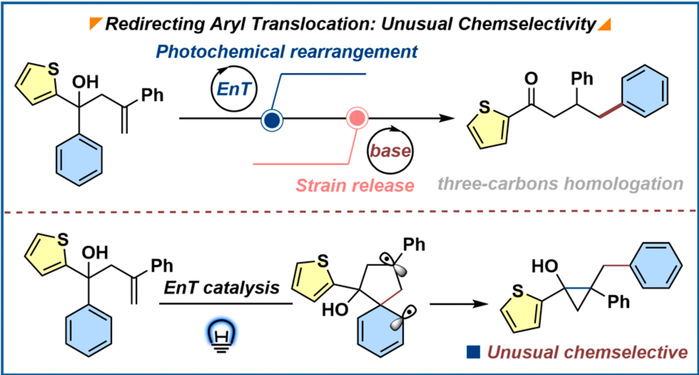
Schematic illustration showing how visible-light photocatalysis redirects aryl translocation pathways.
This finding means that chemists can not only alter the outcome of a reaction but also actively switch between different outcomes by controlling the catalytic mechanism, offering a higher level of control over chemical transformations.
To understand why this unexpected selectivity occurs, the team combined mechanistic experiments with theoretical calculations. Their analysis revealed that the unexpected selectivity is governed not by the initial radical addition step, but by the reversibility of subsequent reaction steps and the energetic barriers of competing pathways.
Beyond its fundamental scientific significance, the method also demonstrates broad practical potential. The researchers showed that it is compatible with a wide range of aromatic compounds and can be applied to the late-stage modification of natural-product derivatives and pharmaceutically relevant molecules. Such precisely controlled reaction strategies may become valuable tools for molecular design, helping researchers build complex molecules more efficiently for applications in drug discovery and advanced materials development.
Wang Qiu-Zhu, Zheng Yu, and Zhang Ying from Prof. Huang’s group are co-first authors of the paper. Prof. Huang is the corresponding author.