
Researchers from ShanghaiTech University and Degron Therapeutics report HuR-targeted molecular glue degraders for BRAF-mutant colorectal cancer in a study published in Nature
Longstanding challenges in the treatment of BRAF‑mutant colorectal cancer
Colorectal cancer is the second leading cause of cancer‑related death worldwide. Clinical data indicate that approximately 10% of patients with colorectal cancer harbor gain‑of‑function mutations in BRAF, with the BRAF V600E mutation accounting for 80%–90% of these cases. Patients with this mutational subtype generally have a poor prognosis, and effective clinical treatments are lacking. BRAF inhibitors such as encorafenib tend to induce negative feedback activation of the mitogen‑activated protein kinase (MAPK) signaling pathway, leading to tumor resistance and treatment failure. Although the combined inhibition of BRAF and the epidermal growth factor receptor (EGFR) has been approved for clinical use, the improvement in patient survival benefit remains limited, and issues of drug resistance and recurrence remain prominent. Therefore, identifying novel therapeutic targets that can overcome drug resistance is of great clinical value.
Unmet needs in targeting the RNA-binding protein HuR
HuR is an RNA-binding protein that promotes tumor cell proliferation, invasion, and drug resistance through post-transcriptional regulation. Despite preclinical attempts to inhibit HuR function using small-molecule targeting or RNA interference, no breakthrough has been achieved in drug development.
Molecular glue degraders offer a new strategy for targeting “undruggable” proteins
Molecular glue degraders represent an emerging targeted protein degradation technology that mediates the interaction between E3 ubiquitin ligases and target proteins, inducing the degradation of target proteins via the ubiquitin‑proteasome pathway. This provides a novel strategy for the development of anti‑cancer drugs and clinical therapy.
Why the ShanghaiTech-Degron collaboration matters
Recently, the laboratory of Professor Yong Cang at the School of Life Science and Technology (SLST), ShanghaiTech University, in collaboration with its spin‑off company Degron Therapeutics, reported a first molecular glue degrader targeting the RNA‑binding protein HuR in a study published in Nature. This study successfully breaks the “undruggable” barrier of HuR. Furthermore, it identifies BRAF mutation as a biomarker for the therapeutic response to HuR‑directed molecular glue degraders and elucidates the molecular mechanism by which HuR directly regulates the oncogene BRAF, providing a new precision therapeutic strategy for relapsed/refractory BRAF‑mutant colorectal cancer.
This study provides the first evidence that degradation of the HuR protein induces aberrant alternative splicing of BRAF pre‑mRNA, leading to downregulation of BRAF protein levels. At the same time, HuR degraders also reduce EGFR expression, thereby blocking reactivation of the MAPK signaling pathway and effectively overcoming acquired resistance to BRAF inhibitors. Unbiased CRISPR library screening further revealed a strong synergistic effect when HuR degraders are combined with EGFR, BRAF, or MEK inhibitors. In patient‑derived xenograft (PDX) models, this combination therapy significantly suppressed the progression of BRAF‑mutant colorectal cancer, offering a novel therapeutic strategy for patients with relapsed/refractory disease (see schematic mechanism in Figure 1).
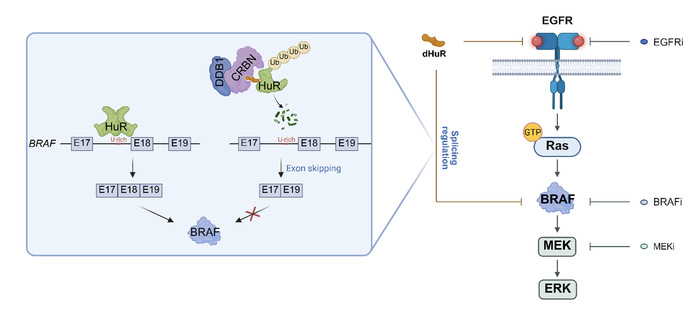
Figure 1. Schematic illustrating the mechanism of the HuR molecular glue degrader in regulating BRAF alternative splicing to downregulate BRAF protein and its synergy with BRAF, EGFR, or MEK inhibitors.
From bench to bedside
Based on the above research findings, Degron Therapeutics has developed DEG6498, the world’s first molecular glue drug targeting HuR. The Investigational New Drug (IND) application for this compound has received approval from the U.S. FDA and China’s NMPA (acceptance numbers: IND174949; CXHL2500454). An ongoing Phase I clinical trial (ClinicalTrials.gov NCT07244835) will evaluate its safety and preliminary efficacy in patients with solid tumors, including BRAF‑mutant colorectal cancer.
Lu Xiaocui (third-year doctoral student), Wang Xiuyun (fourth-year doctoral student), and Wang Xusheng (second-year doctoral student) from the SLST, along with Yang Zheng from Degron Therapeutics, are co‑first authors of the paper. Professor Cang Yong, who is also the co-founder and chief scientist of Degron Therapeutics, together with Su Hexiu and Dou Hao from Degron Therapeutics are co-corresponding authors. ShanghaiTech University is the primary affiliation of this paper.
*This article is provided by Prof. Cang Yong