—ShanghaiTech as one of the science education bases of Shanghai Science Festival 2026
If laboratories are where scientific discoveries begin, then this year’s Shanghai Science Festival opened a gateway for young visitors to step into that world for themselves.
One of the science education bases of the festival, ShanghaiTech University welcomed a group of curious primary and secondary school students to experience science beyond textbooks. From national key laboratories to the microscopic wonders revealed through advanced imaging technologies, and from hands-on experiments to face-to-face conversations with researchers, through observation, exploration, and interaction, they gained a closer look at how scientific discoveries are made and how emerging technologies may shape the future.
For many students, entering a real research laboratory was one of the most memorable experiences of the festival. Facilities that normally serve scientific research opened their doors to the public, bringing cutting-edge science out of journals and headlines and into direct view.
Visitors explored a laboratory dedicated to quantum materials research, learned about advances in brain science, medical imaging, and bioelectronics in biomedical engineering laboratories, and embarked on a journey into the microscopic world through electron microscopy. For many, it was the first time seeing the intricate structures of dragonfly eyes, butterfly wings, and even individual atoms with their own eyes.
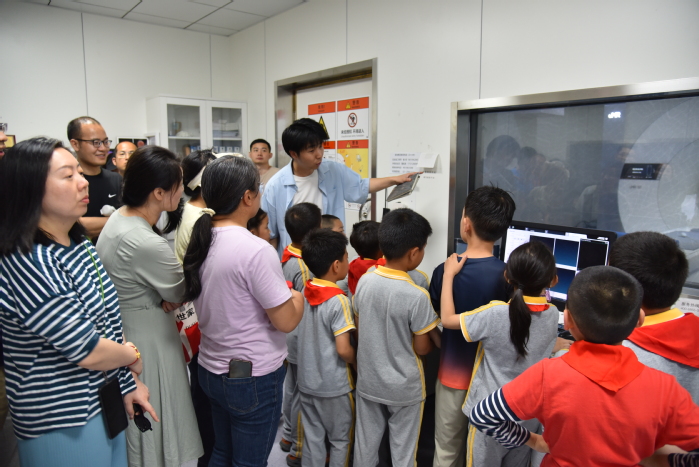
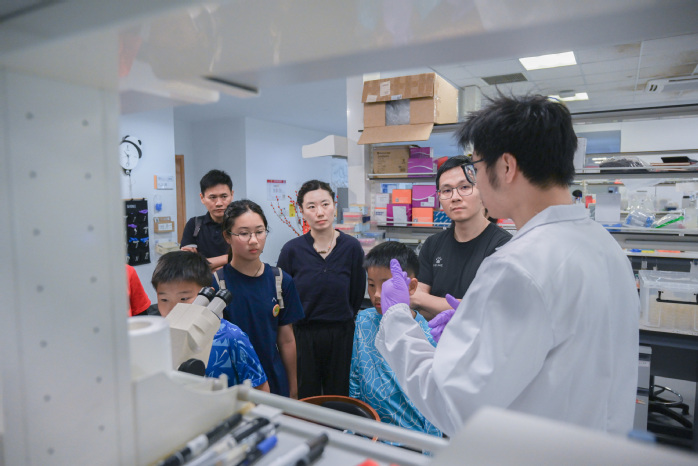
Visitors explore biomedical engineering and life sciences laboratories.
Yet the festival was not only about seeing science—it was also about doing science.
At the School of Physical Science and Technology, children created cyanotype artworks, designed bookmarks that change color with temperature, and explored the principles behind chemistry and physics through a series of engaging experiments. At the School of Life Science and Technology, they observed laboratory nematodes and learned how neurons connect to form neural circuits. At the iHuman Institute, young visitors became “junior scientists,” recording observations, organizing data, and experiencing the process of scientific inquiry firsthand.
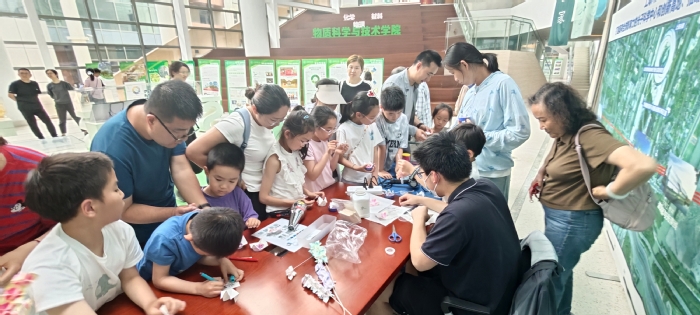
Visitors do experiments at the School of Physical Science and Technology.
Science was no longer a collection of concepts in a textbook. It became a process of asking questions, testing ideas, and discovering answers through participation.
The spirit of inquiry continued through a series of popular science lectures. Researchers introduced topics ranging from brain-computer interfaces and functional brain imaging to photon-counting spectral CT and magnetic resonance imaging (MRI), translating complex scientific concepts into accessible and engaging conversations. Children eagerly raised their questions and expanded their understanding of the world through dialogue with scientists.
While the festival has come to a close, science outreach at ShanghaiTech continues throughout the year.
The university has long encouraged researchers to bring science beyond campus, engaging with schools, communities, and public cultural institutions such as the Shanghai Science and Technology Museum and the Shanghai Astronomy Museum. By extending scientific resources into broader society, ShanghaiTech helps create more opportunities for the public to engage with science in everyday life.
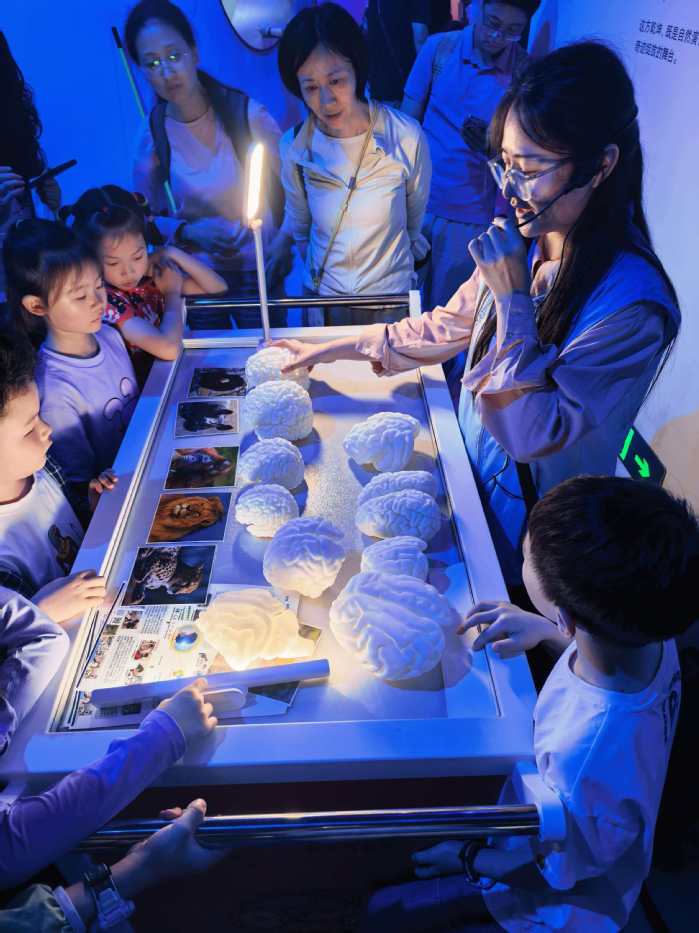
Researchers from biomedical engineering bring science popularization to the public in the Shanghai Science and Technology Museum.
When curiosity is encouraged and questions are welcomed, the seeds of scientific exploration begin to grow. ShanghaiTech will continue building bridges between science and society, inspiring more people to explore, understand, and participate in the pursuit of discovery.