When Guan Jingrong ’26 arrived at ShanghaiTech University in the summer of 2022, he did not have a detailed future plan or a clear academic goal. Like many first-year students, he believed that studying hard and earning good grades were the keys to success. “I didn’t know what I really wanted. I only knew how to get good grades to prove myself.”
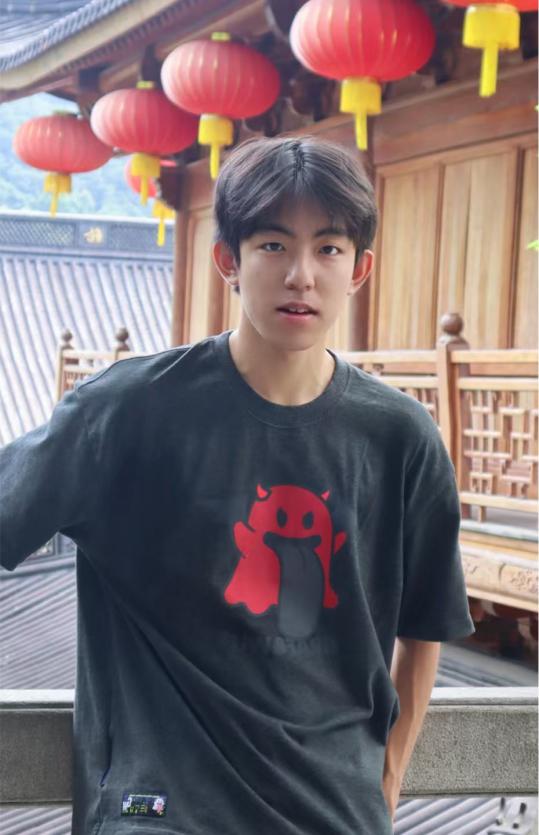
Four years later, after completing his bachelor’s study in mathematics with multiple academic honors, and after earning admission with full funding to the PhD program in Industrial Engineering and Management Sciences at Northwestern University, he has come to a different conclusion.
“The most important thing about university is not proving how good you are,” he says. “It’s discovering what you truly care about.”
That realization did not come overnight. It emerged gradually through years of exploration, setbacks, reflection, and growth.
Learning to explore
During his first year at ShanghaiTech, Guan devoted most of his energy to coursework. Academic achievement brought a sense of accomplishment, but it did not fully answer a question that lingered in his mind: Was this really the university experience he wanted?
Conversations with his academic advisor prompted him to think more deeply about the future. He began to realize that university was not simply a place to accumulate grades, but an opportunity to discover new interests and possibilities.
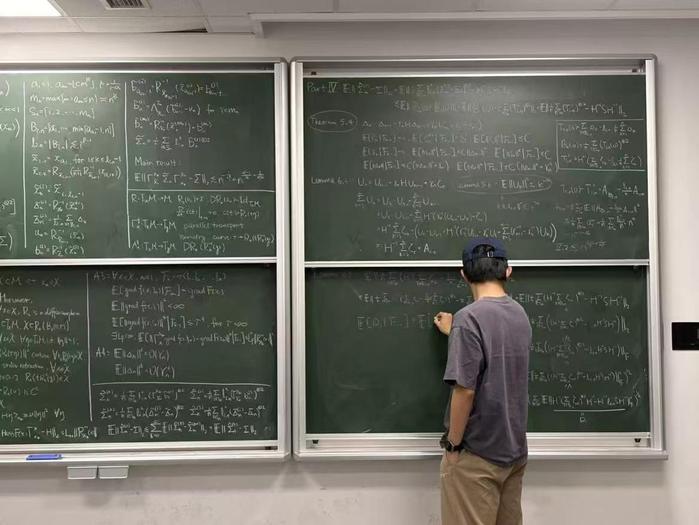
Guan Jingrong works independently on a mathematical proof.
He started venturing beyond his comfort zone. He challenged himself with advanced mathematics courses, explored unfamiliar research literature, and searched for topics that genuinely sparked his curiosity. Outside the classroom, he returned to the soccer field and joined volleyball training sessions, rediscovering the joy of pursuing interests beyond academics.
Gradually, the uncertainty that had once made him anxious became something worth embracing. The path that had once seemed focused solely on academic performance began to open toward broader horizons.
Growing through uncertainty
Exploration in mathematics, however, was rarely straightforward—some mathematical concepts seemed almost impossible to grasp; research often felt equally daunting; reading papers in unfamiliar fields required repeated effort just to understand the basic ideas; and simple-looking mathematical proofs frequently became tangled in subtle but critical details. Many promising ideas revealed flaws once written down, while long hours of work sometimes yielded little visible progress.
“There was a period when I was afraid to talk with professors,” Guan recalls. “I always felt that I hadn’t accomplished enough.”
Yet those moments of frustration ultimately became some of his most valuable lessons.
Over time, he learned that effort and outcomes do not always follow a predictable path. Success often depends on timing and circumstance, while persistence depends on personal conviction. Failures rarely provide immediate answers, but they gradually build resilience, patience, and perspective. What once felt like obstacles became stepping stones toward maturity.
Looking beyond the classroom
One of Guan’s most transformative experiences came during a field immersion program in Liangshan Mountain Region, Sichuan Province, one of the underdeveloped regions in China, in the summer of 2023. As team leader, he spent months organizing the program—from designing research plans and coordinating logistics to managing unexpected challenges in the field. The experience taught him how to stay calm under pressure and take responsibility for both the project and his teammates.
But the deeper impact came from what he witnessed.
Traveling through mountainous communities, Guan encountered realities that could never be fully understood through textbooks alone. He saw how difficult terrain shaped everyday life, how national poverty alleviation policies had created new opportunities for local residents, and how challenges such as educational inequality continued to affect rural communities.
For the first time, he began to appreciate the complexity of many real-world problems.
“There are questions that don’t have a single correct answer,” he says. “They require not only rational analysis, but also empathy and understanding.” The experience broadened his perspective beyond academics and strengthened his sense of social responsibility.
Finding a direction
Another turning point came through ShanghaiTech’s international study program, which gave Guan the opportunity to study at the University of California, Berkeley for one semester.
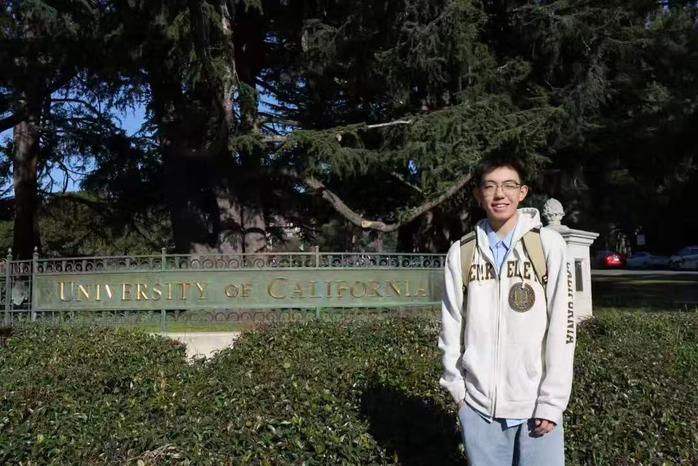
There, he encountered a vibrant academic environment where mathematics, optimization, statistics, and machine learning intersected much deeper. Exposure to new ideas and disciplines helped him connect concepts that had previously seemed separate and revealed research possibilities he had never considered.
Through sustained research training and close mentorship, he gradually developed a more mature understanding of what it means to pursue scientific inquiry.
Rather than rushing toward quick results, he learned to appreciate the process itself—to ask better questions, refine ideas, and build knowledge patiently over time. The uncertainties that once intimidated him no longer felt like barriers. Instead, they became a natural and even rewarding part of research.
Continuing the journey
In 2026, Guan was honored with the Graduate Excellence Award of ShanghaiTech University. This fall, he will begin his doctoral studies at Northwestern University.
Looking back, he sees his undergraduate years not as a straight path toward a predetermined destination, but as a journey of continuous exploration and self-discovery.
From classrooms to mountain villages, from Shanghai to Berkeley, each experience contributed to a deeper understanding of both the world and himself.
The answers he once sought did not arrive all at once. They emerged gradually through curiosity, perseverance, and the willingness to venture into the unknown.
As he prepares for the next stage of his academic journey, Guan knows that many questions still lie ahead. But he has also learned something equally important: growth is not about finding every answer as quickly as possible. It is about continuing to explore, learn, and move forward with purpose.