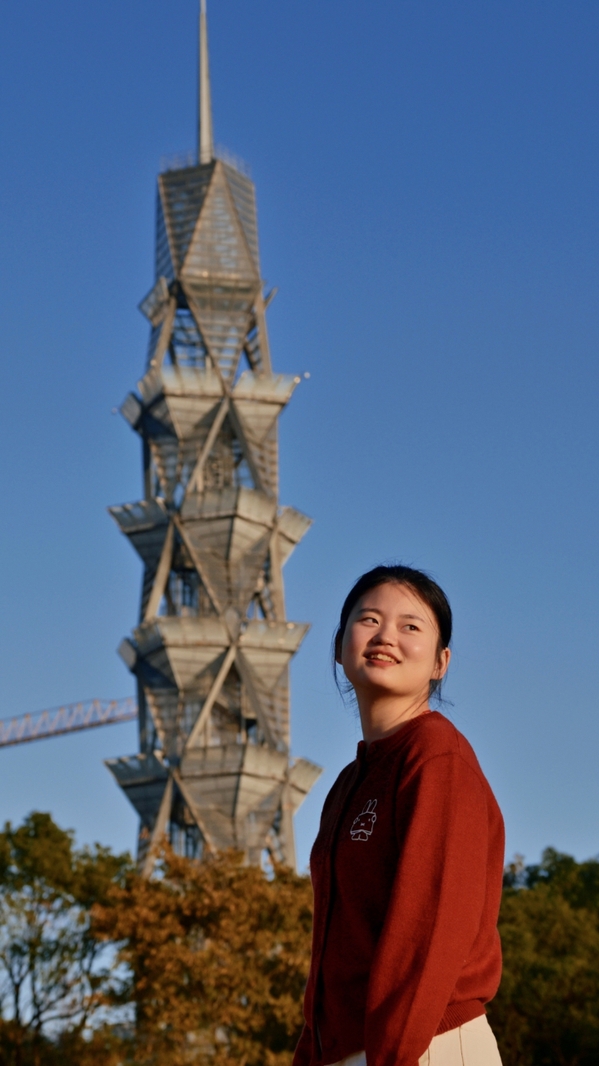
While many researchers gravitate toward popular and well-established fields, Cao Yu PhD ’26 chose a path few are willing to take.
Her research focuses on neuroblastoma, a highly aggressive childhood cancer. Because the disease affects relatively few patients and developing new treatments requires significant investment, pharmaceutical companies often have limited commercial incentive to pursue drug development in this area. As a result, treatment options remain limited. Drugs developed for such rare conditions are often referred to as “orphan drugs” because they have historically received less attention than treatments for more common diseases, leaving many children and their families facing an uncertain and difficult journey.
After completing her bachelor’s degree, Cao began her graduate studies at ShanghaiTech University where she learned about neuroblastoma through conversations with her advisor, Associate Professor Bai Fang. Having grown up healthy herself, she found it difficult to imagine the suffering endured by young patients and their families. She was also struck by a troubling reality: despite remarkable advances in modern medicine, some diseases continue to receive little attention simply because too few people are affected.
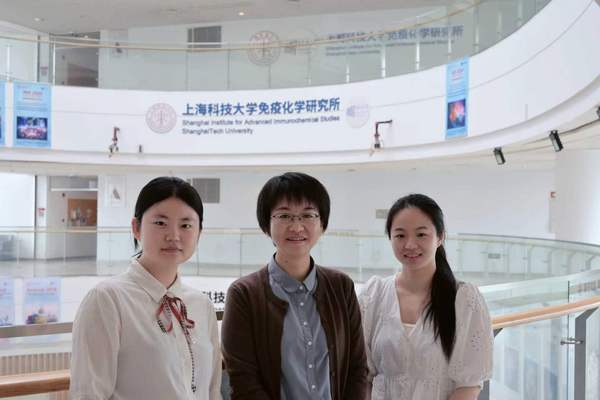
Cao Yu (left) and her advisor Prof. Bai Fang (center).
That realization shaped a decision that would define her doctoral years. She chose to devote herself to orphan drug research. But, it was not an easy choice.
Drug discovery is often described as a marathon—one that demands years of effort with no guarantee of success. Developing orphan drugs is even more challenging, requiring substantial investment while serving a relatively small patient population. Yet Cao remained convinced that the value of scientific research extends beyond publications and academic achievements. At its core, she believed, research should improve lives.
The challenges came quickly. Before entering ShanghaiTech, Cao had never written a line of code. Yet her research required her to learn computer-aided drug design and eventually work with AI tools for drug discovery. Mastering new technologies was only part of the challenge. The scientific problem itself was notoriously difficult, offering few established solutions and demanding constant exploration into uncharted territory.
There were moments of confusion, frustration, and disappointment. Promising ideas failed. Experimental results fell short of expectations. New approaches often meant starting over from the beginning.
Still, she stayed the course.
With each setback, she gained experience. With each failure, she learned something new. Years of persistence eventually led to a breakthrough.
Combining the research group’s extensive expertise with an AI-powered drug discovery platform, the team identified and optimized a promising drug candidate. In animal studies, the compound demonstrated strong anti-tumor activity, significantly suppressing tumor growth and reducing the risk of recurrence. The work was later selected for presentation at the 2025 Annual Meeting of the American Association for Cancer Research (AACR), one of the world’s leading cancer research conferences.
For Cao, however, the most meaningful moment was not receiving recognition from the scientific community. It was realizing that the work taking place in a laboratory might one day help real patients.
“That was when I truly felt that what we were doing could make a difference in someone’s life,” she recalled.
Yet scientific discovery is only the beginning.
For rare diseases, the journey from laboratory research to clinical application is often as difficult as the research itself. Regulatory requirements, safety evaluations, clinical studies, funding, and commercialization all stand between a promising discovery and a treatment that can reach patients. Many scientific advances never make it beyond the laboratory.
Fortunately, with the support of her advisor and ShanghaiTech’s innovation and entrepreneurship ecosystem, Cao became deeply involved in the project’s next stage, helping refine the technology, strengthening the supporting data, and facilitating its translation. In August 2025, the technology was licensed for commercialization, marking an important step toward real-world application. To Cao, the agreement represented far more than a successful technology transfer. It symbolized the possibility that years of research might one day bring hope to children and families confronting a devastating disease.
“I am not the most talented person,” she said. “I’ve simply been fortunate enough to work in an environment where I could keep pursuing something I truly believe is meaningful.”
Beyond the laboratory, Cao has always believed that science should be shared with society. During her doctoral studies, she volunteered, for two consecutive years, at the science summer camp organized by Pudong New Area, introducing young students to the world of drug discovery and development. By sharing both the excitement and the challenges of scientific research, she hoped to inspire curiosity and a lasting interest in science among the next generation.
As graduation approaches, Cao has chosen to remain at ShanghaiTech as a postdoctoral researcher at the SIAIS, continuing her work in orphan drug development. The scientific questions ahead remain challenging, but she welcomes the opportunity to explore the unknown.
“ShanghaiTech has always encouraged innovation and embraced new ideas,” she said. “It gives young researchers the freedom to pursue ambitious goals and explore possibilities that may seem out of reach.”
Looking further ahead, Cao hopes not only to help translate scientific discoveries into real-world treatments, but also to follow in the footsteps of her mentor by becoming both a researcher and an educator—someone who can guide and support future generations of young scientists.
From an uncertain newcomer to a researcher helping advance a promising therapy toward real-world impact, Cao’s journey has been anything but easy. Yet she remains guided by the same conviction that first drew her to orphan drug research years ago. Some challenges are worth pursuing, even when the path is long.
Because patients living with overlooked diseases deserve new hope. And someone has to help create it.