

The development of a fertilized egg into a complete organism, as well as the regeneration and repair of injured adult tissues, is orchestrated by the Wnt signaling pathway, which functions as a central “switch.” How this “switch” is turned on, however, has remained a major mystery in the life sciences—one that resisted resolution for nearly 40 years.
On May 27, Professor Xu Wenqing and his team from the School of Life Science and Technology (SLST) at ShanghaiTech University published a study in Cell that finally answers this question. The study reports the first high-resolution three-dimensional structure of the extracellular Wnt signalosome complex, systematically revealing its activation mechanism and providing a critical blueprint for the treatment of related diseases.
A central “switch” in biology and a longstanding challenge
The Wnt signaling pathway plays important roles in key biological processes such as cell proliferation, migration, differentiation and apoptosis, and is involved in embryonic development, tissue regeneration and tissue homeostasis. Dysregulation of this pathway can lead to various diseases, including developmental defects, tissue fibrosis, metabolic disorders, and cancer. Among them, the canonical Wnt/β-catenin signaling pathway is the best studied, and its activation relies on the Wnt signalosome complex formed by Wnt ligands, Frizzled (Fzd) receptors, and LRP5/6 co-receptors. However, the mechanism by which Wnt ligands simultaneously engage both Fzd receptors and LRP5/6 co-receptors to activate the Wnt/β-catenin pathway has remained an core unresolved question in the field.
Two main hypotheses have been proposed for the activation mechanism of the canonical Wnt pathway. One is the “allosteric activation model,” based on Fzd being a GPCR. The other is the “clustering activation model,” in which Wnt serves as a “crosslinker” to cluster the receptors. Due to the extreme difficulty in preparing recombinant Wnt proteins, together with the poor stability and high heterogeneity of the Wnt signalosome complex, structural determination has progressed slowly over the past nearly 40 years—a well-recognized and formidable challenge in the field.
What the structure reveals
After nearly six years of painstaking research, Prof. Xu’s team finally surmounted this challenge. They successfully obtained the stable Wnt3a/Fzd8/LRP6 ternary complexes and resolved their high-resolution three-dimensional structure using single-particle cryo-electron microscopy (cryo-ET).
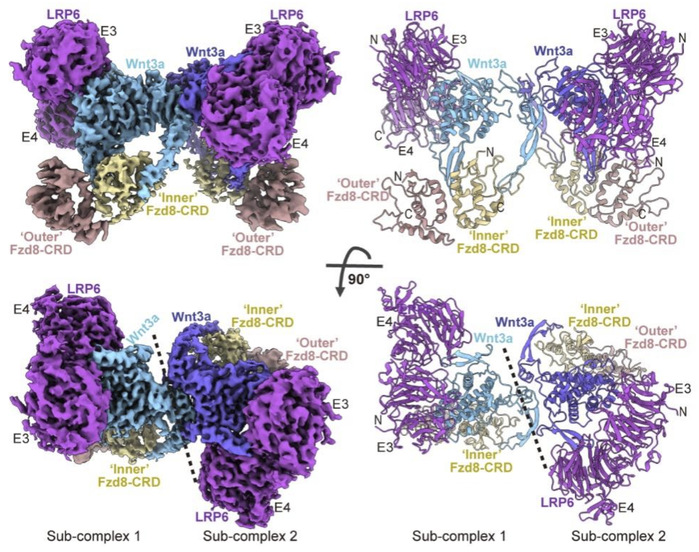
Structures of the Wnt3a/Fzd8/LRP6 ternary complexes.
In the complex structures, Wnt, Fzd, and LRP6 assemble at a stoichiometric ratio of 2:4:2 (two Wnt molecules for every four Fzd receptors and two LRP6 co-receptors). The Wnt3a homodimer forms the core scaffold of the entire signalosome, with each Wnt3a monomer binding two Fzd8 receptors and one LRP6 co-receptor, thereby crosslinking four receptors and two co-receptors into an ordered functional unit. This provides direct and compelling structural evidence for the “clustering activation model.” Further experiments, including site-directed mutagenesis, Wnt signaling activity assays, and live-cell imaging, confirmed that disrupting the Wnt3a dimerization interface completely blocks receptor clustering and downstream signaling activation, highlighting the essential role of the Wnt dimer.
This study not only uncovers the mechanism of signaling initiation but also elucidates the subsequent cascade in signal transduction. Wnt3a-induced tetramerization of Fzd create a multivalent platform for the recruitment of oligomeric Dvl, thereby cooperatively amplifying and transmitting the signal downstream. Furthermore, the team precisely mapped the Wnt-LRP6 interface and identified a Wnt3a mutant with enhanced activity, providing a solid structural foundation for drug design targeting the Wnt pathway and the development of regenerative medicine tools.
Why it matters for medicine
This study, for the first time, reports the high-resolution three-dimensional structures of the extracellular Wnt signalosome complexes, providing key insights into how native Wnt ligands simultaneously bind Fzd receptors and LRP5/6 co‑receptors to form the Wnt signalosome and thereby activate the downstream signaling pathway. It also provides direct structural evidence for the Wnt‑induced receptor clustering activation model.
The structure of the Wnt/Fzd/LRP ternary complex serves as a critical foundation for drug development, facilitating the design of effective therapeutic strategies against Wnt‑related cancers, tissue fibrosis, and other diseases. In addition, it will guide the rational design of next‑generation Wnt surrogates for applications in the regeneration of tissues such as lung and liver, as well as in organoid culture.
Dr. Yue Dan in Prof. Xu’s group is the first author, and Prof. Xu is the corresponding author.
*This article is provided by Prof. Xu.