Luo Jianwen ’21, MS ’23 is a 2023 PhD student at the School of Information Science and Technology (SIST), under the supervision of Professor Ha Yajun. His research focuses on mathematical optimization and quantum acceleration in electronic design automation (EDA). As first author, he has published papers in international journals including IEEE Transactions on Circuits and Systems I (TCAS-I) and IEEE Transactions on Computers (TC), and received the Best Paper Award at the 2022 IEEE Asia Pacific Conference on Circuits and Systems (APCCAS). In 2025, he was awarded the National Scholarship for Doctoral Students.
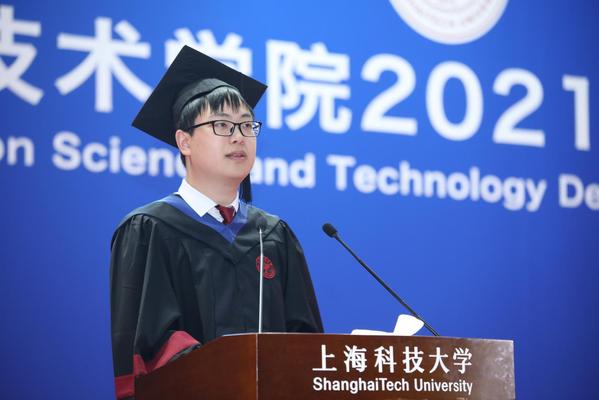
Luo Jianwen delivers remarks as an undergraduate representative at the 2021 SIST commencement.
To many people, chip design is a highly engineering-driven field. To Luo Jianwen, however, it resembles a complex mathematical puzzle. His research aims to make chip design more efficient and precise through mathematical methods.
“My work can essentially be summarized in two parts,” he explains. “First, I use mathematics to clearly describe problems in chip design. Second, I look for more powerful computational approaches to solve those problems faster and better.”
From broad exploration to finding a true passion
Luo’s research journey began during his undergraduate years at ShanghaiTech.
As an undergraduate, he explored a wide range of fields, including robotics, light-field imaging, non-line-of-sight imaging, and FPGA chips. Rather than distracting him, these seemingly diverse experiences gradually helped him identify the kinds of problems that genuinely interested him.
Eventually, he returned to the field that had first attracted him most: EDA. He then joined Professor Ha Yajun’s research group to continue pursuing this direction.
During his undergraduate thesis project, Luo proposed a new optimization approach for network-on-chip FPGA placement. The project was recognized as an outstanding undergraduate thesis at ShanghaiTech, later won a Best Paper Award at an international conference, and was eventually published in an international journal.
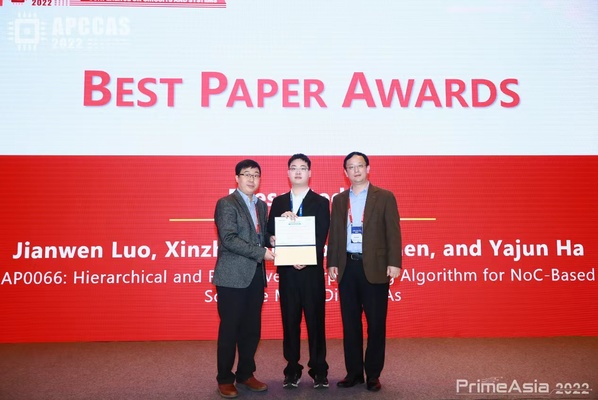
Luo Jianwen’s paper wins a Best Paper Award at IEEE APCCAS 2022.
This continuous progression from undergraduate research to doctoral study also helped him realize that what truly fascinated him was not simply “building chips,” but solving complex engineering problems through mathematical thinking.
Balancing practical engineering and forward-looking exploration
Luo’s current research mainly follows two directions.
One focuses on practical engineering problems. Using mathematical tools such as integer linear programming, he transforms complex EDA tasks into precisely solvable mathematical models, and then applies high-performance solvers to search for optimal solutions. In his view, this approach not only improves chip design efficiency, but also makes it possible to evaluate how close a solution is to the theoretical optimum.
The other direction is more exploratory and future-oriented. He is investigating how to translate traditional optimization problems into forms that can be processed by quantum computing systems, with the goal of using quantum computing to further accelerate EDA problem solving in the future.
Although these two directions appear quite different, Luo believes they ultimately share the same goal: finding more efficient ways to solve increasingly complex problems.
Staying relaxed while staying committed
Despite his growing list of achievements, Luo does not place excessive pressure on himself over publication numbers.
“Truly good ideas don’t come along that often,” he says. “In many cases, the pace of research is actually determined by the journal review process.”
This relatively calm mindset has allowed him to maintain a stable and sustainable rhythm in research.
In the laboratory, he is also known as someone always willing to help others. Whether discussing research ideas, refining figures, or improving the logic of a paper, he enjoys collaborating with fellow students. In his view, scientific research is never an individual endeavor, and many valuable ideas emerge through discussion and teamwork.
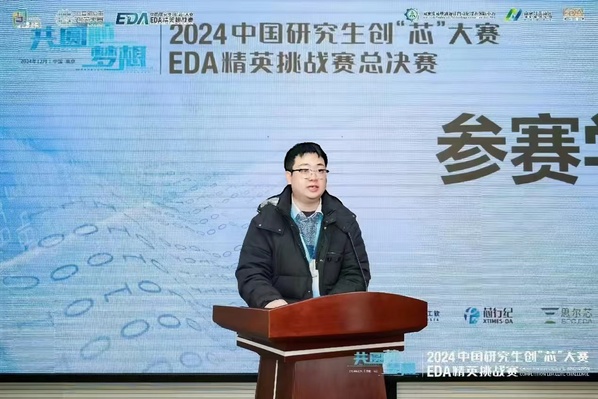
Luo Jianwen speaks as a student representative in a national-level EDA competition.
Through the process of responding to rigorous peer review and repeatedly revising theoretical work, he has also come to appreciate another important aspect of research: it is not enough to solve difficult problems—researchers must also learn how to explain clearly why their work matters.
“Doing theoretical research is not only about going deeper,” he says. “It is also about helping others understand the significance of your work.”
Continuing to grow through real-world challenges
Luo also has a clear and pragmatic perspective on his future.
While entrepreneurship has become increasingly popular in recent years, he believes that the better path for him at this stage is to first gain experience in industry, develop a deeper understanding of real engineering challenges, and then think about how research can be translated into broader practical applications.
From exploring multiple disciplines as an undergraduate to focusing on EDA optimization and quantum acceleration research during his doctoral studies, Luo has consistently maintained both curiosity about technology itself and a rational understanding of his own goals.
To him, research is not a race for quick success, but a long-term journey of discovering problems, understanding them, and ultimately finding better solutions.