

Fan Yuhang is a 2021 PhD student at the School of Life Science and Technology (SLST) under the supervision of Professor Chen Jia. His research focuses on the development and mechanistic study of mitochondrial base editing systems. He has received honors including ShanghaiTech’s Outstanding Student Award and Excellent Student Award.
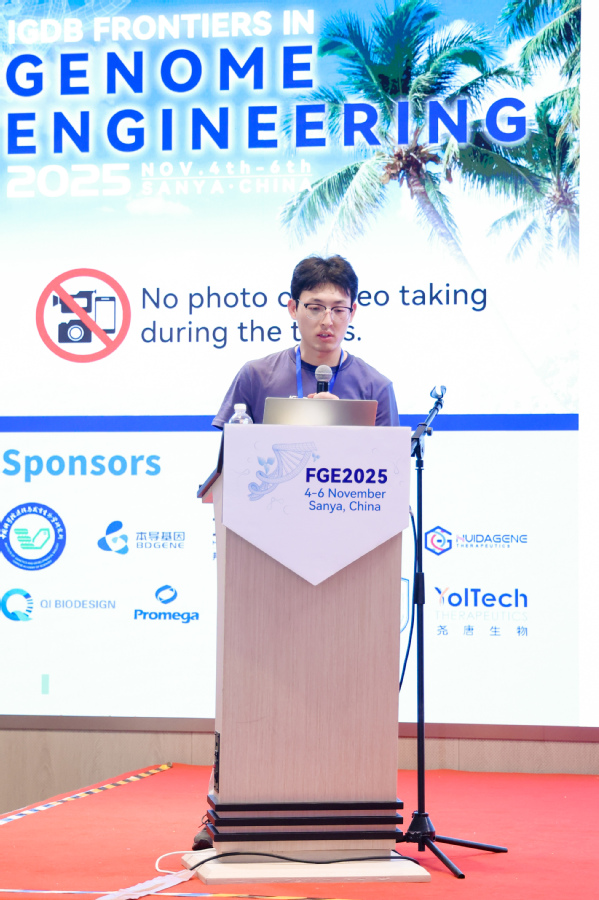
In the laboratory at ShanghaiTech, Fan Yuhang can often be seen moving between the bench and the computer, carefully analyzing experimental data and sequencing results. As a recipient of the 2025 National Scholarship for Doctoral Students, he has continued exploring the frontiers of gene editing by tackling fundamental scientific questions. From an early fascination with DNA in high school to publishing research in Nature Biotechnology, he has remained committed to advancing life science research and contributing to the future of human health.
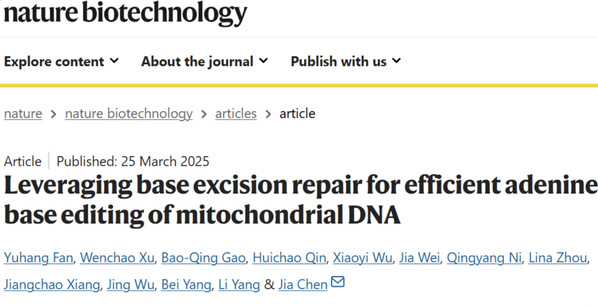
Screenshot of the paper published in Nature Biotechnology
From fascination with DNA to a commitment to scientific research
Fan’s interest in life science began in high school. “I was fascinated by the illustration of the DNA double helix in my biology textbook,” he recalls. “It amazed me that neatly arranged bases could determine the countless forms of life.” This curiosity about the essence of life inspired him to pursue a future in biological research from an early age.
In 2017, he enrolled in the School of Biotechnology at East China University of Science and Technology, where he began his scientific training at the State Key Laboratory of Bioreactor Engineering. From basic experimental techniques to research project design, the experience helped him build a solid academic foundation while also deepening his understanding of scientific research: It is not merely theoretical discussion, but a process of approaching truth through repeated experimentation, trial and error, and continuous reflection.
After completing his undergraduate studies, Fan enrolled in ShanghaiTech as a recommended graduate student (exempted from entrance exam) and began his journey in gene editing research. During laboratory rotations, he was deeply inspired by the gene editing technologies developed in Professor Chen Jia’s research group. In his view, gene editing is not only a powerful tool for understanding life, but also a promising approach for the treatment of genetic diseases. The combination of scientific frontier research and real-world impact motivated him to devote himself fully to this field.
Pursuing answers through persistent exploration
After joining the research group, Fan focused his work on mitochondrial gene editing. Often referred to as the “powerhouse” of the cell, mitochondria are closely linked to many hereditary diseases through mutations in mitochondrial DNA. However, existing editing tools still faced significant challenges in both efficiency and mechanistic understanding.
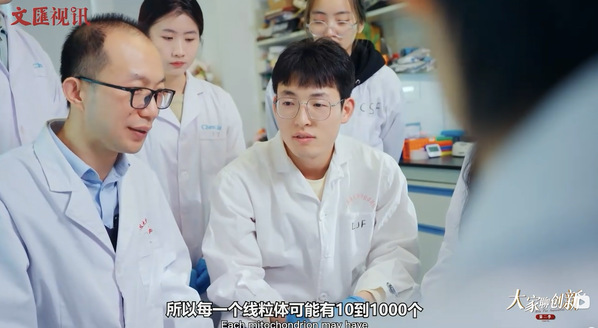
Screenshot of the media interview with Prof. Chen Jia’s group (Fan is in the center).
Rather than simply accepting experimental anomalies as errors, Fan developed the habit of looking for patterns behind unexpected observations. During repeated experiments, he noticed that some results did not fully align with existing theories. Instead of overlooking these inconsistencies, he continued asking deeper questions: could these unexpected phenomena point to an undiscovered mechanism?
Driven by this line of thinking, he spent extensive time reviewing literature, discussing ideas with teammates, and repeatedly verifying hypotheses through experiments. After long periods of exploration, the team eventually uncovered an important mechanism underlying the editing system and further optimized the tool based on these findings.
The work was later published in Nature Biotechnology. For Fan, the significance of the achievement goes beyond publication itself. More importantly, the experience helped him better understand the essence of scientific research—science is not simply about repeating established conclusions, but about continuously observing, questioning, and verifying ideas in the pursuit of truth.
Broadening scientific horizons through communication and collaboration
Beyond his research in the laboratory, Fan has always maintained an open academic mindset and actively participated in scientific exchanges and collaborations. He has delivered presentations and presented posters at domestic and international conferences, engaging in discussions with researchers from different fields.
“Scientific research is never an isolated endeavor. Instead, it is through communication, collaboration, and the exchange of ideas that researchers broaden their perspectives and gain new inspiration.” Fan said.
“I believe that young researchers should not only devote themselves to rigorous laboratory work, but also step onto broader academic platforms to continuously deepen their scientific thinking and research capabilities.”
Advancing life science research to benefit human health
From his early curiosity about DNA in high school to his ongoing exploration of gene editing today, Fan has remained deeply passionate about life science research. He believes that the meaning of life science lies not only in understanding life itself, but also in improving human health through scientific advancement.
“The exploration of life science has no end,” Fan says. “I hope to continue moving forward on the path of scientific research and help bring the benefits of science to more people through my work.”