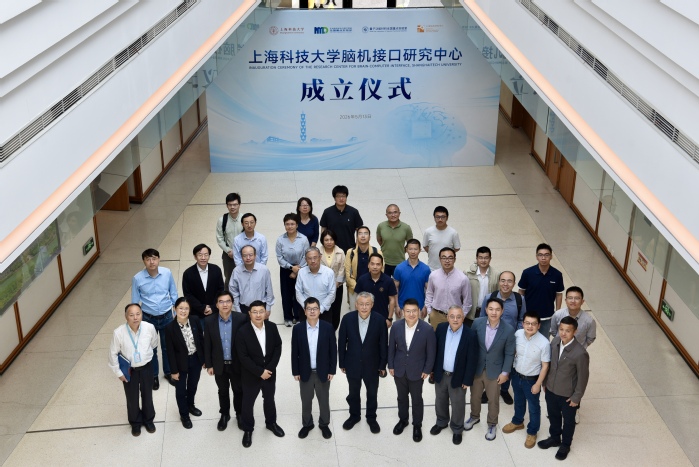

ShanghaiTech University officially launched its Research Center for Brain-Computer Interface (BCI) on May 13, aiming to advance cutting-edge research in brain-machine integration.
The inauguration ceremony was held at the university’s Conference Center. Distinguished guests attending the ceremony included Zheng Hairong, academician of the Chinese Academy of Sciences (CAS) and executive vice president of Nanjing University; Gu Ning, CAS academician and professor at Nanjing University; Ming Dong, vice president of Tianjin University; Pan Gang, director of the State Key Laboratory of Brain-Machine Intelligence at Zhejiang University; Wu Jinsong, professor at Huashan Hospital; and Fan Qiuyun, professor at Tianjin University, among other leading experts.
Representing ShanghaiTech University were Li Ruxin, party secretary and CAS academician; Yu Jingyi, vice president and vice provost; and Luo Zhenge, vice president.
In his address, Li Ruxin noted that brain-computer interfaces represent an emerging frontier at the intersection of brain science, artificial intelligence, biomedical engineering, and clinical medicine, with broad strategic significance and strong potential to improve human health and well-being. He stated that ShanghaiTech will leverage its interdisciplinary strengths and integrate high-quality innovation resources from within and beyond the university to accelerate breakthroughs in key BCI technologies and their clinical translation.
Shen Dinggang, founding dean of the School of Biomedical Engineering, introduced the Center’s development plan, focusing on research in brain science and neural mechanisms, neural interfaces and implantable systems, intelligent brain-computer systems, and clinical translational applications, with a goal of building an open and collaborative interdisciplinary innovation platform.
Li Ruxin and Shen Dinggang jointly unveiled the plaque for the Research Center for Brain-Computer Interface.
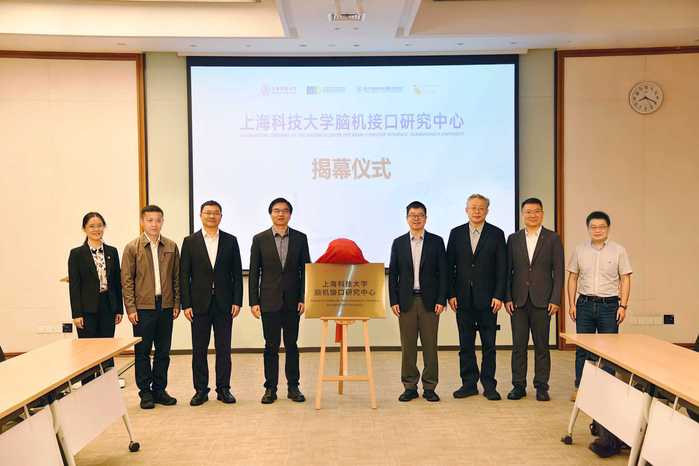
Li Ruxin (fourth from right) and Shen Dinggang (fourth from left) jointly unveil the plaque for the Center.
Following the ceremony, professors from the life sciences and biomedical engineering shared recent progress, covering topics including neural mechanisms and brain-computer interfaces, ultra-flexible neural interfaces and bidirectional BCI interaction technologies, invasive Chinese-language brain-computer interfaces, and the integration of large AI models with BCIs for early screening and intervention in Alzheimer’s disease.
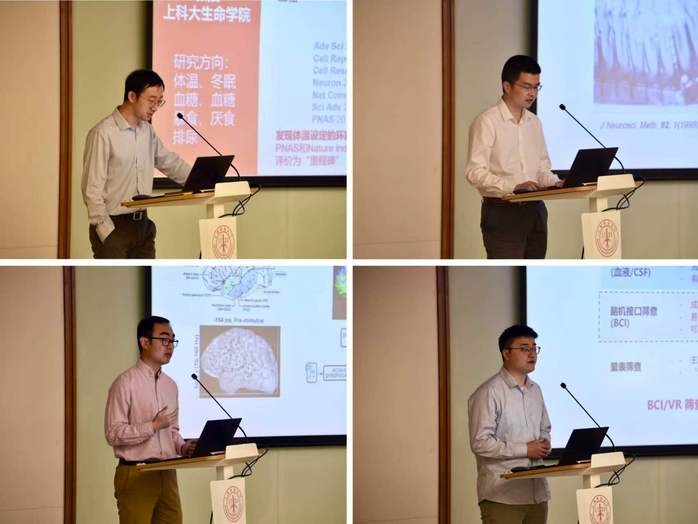
Professors from the life sciences and biomedical engineering share recent research findings.
In the subsequent expert advisory session, participating scholars offered valuable recommendations regarding the Center’s positioning, interdisciplinary collaboration, clinical applications, technology transfer, and talent development. The experts agreed that the Center’s research directions are well-aligned with ShanghaiTech’s strengths and address major scientific challenges and real clinical needs. They further suggested strengthening multidisciplinary collaboration and deeper integration between medicine and engineering to accelerate the transition of BCI technologies from laboratory research to real-world clinical applications.

Scholars offer valuable suggestions and perspectives.
The establishment of the ShanghaiTech’s Research Center for BCI marks a significant step forward in the university’s development at the intersection of brain science and intelligent technologies.